Full information on Volume profile indicator

What is the volume profile indicator? 

Volume profile is a charting feature that shows the traded volume amount of an asset, over a specified period at certain levels’ volume profile shows this data as a histogram in a y-axis next to price levels

Volume profile uses the past traded volume and all the strategies and plans are coming from historical data.
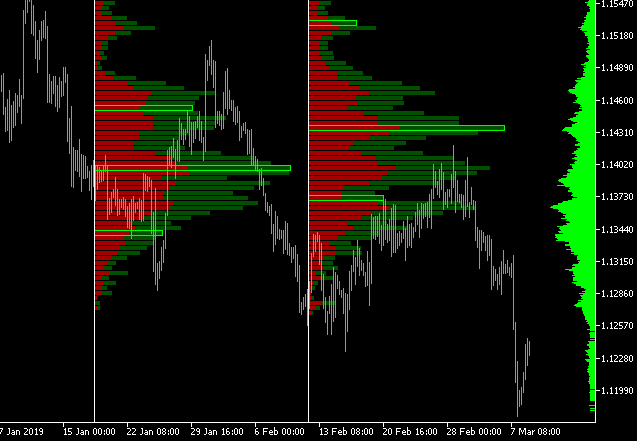
How are these volume profile bars created? 

It takes total volume traded at a price, in a specific time period, and divides total buys and sell volumes and shows it on a histogram chart.

Traders can understand and use these volume profile indicators as the most powerful tools in their trading.

Different types of volume profile:There are three different types of volume profile. These types are not so much different in what they do. Their difference is how they show on your chart and the exact time period you want to see

Visible range(vpvr) volume profile visible tool that everyone uses it comes next to price level as a histogram Vpvr automatically shows the volume traded in the price level from the candles shown on the screen. If you charge or go back and forth in your price actions time period, the volume profile visible range will change

Fixed range volume profile fixed range is the exact same volume profile with a minor difference. 

When you want to see the traded volume in a time period of price action such as an uptrend or downtrend, you can define the start and end point and see the volume profile only for that time period. 

The benefits of using vpfr is that the volume profile Will not change by scrolling in the chart, and it always shows the traded volume in the price levels only for a selected amount vof candle.

Session volume (vpsv) Volume profile session volume shows the volume profile for all sessions shown on a chart. 

You see a divided volume profile for each session presenting on the chart. Each session is considered a day, and it is the same with the change time period of the charts. 
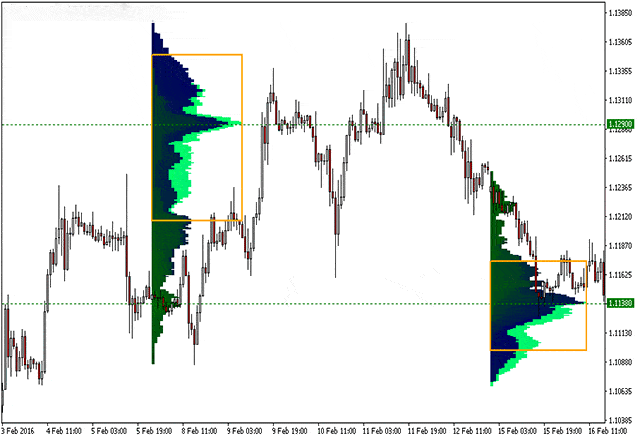
What is volume profile strategy?

The volume profile strategy is basically a study of the volume based on price. This is a bit different compared to the regular volume bars. This is then categorized into the buy volume or sell volume and makes this information available visually as it is plotted on a histogram on the y-axis.The longer horizontal volume bars are the ones of interest. These bars represent the price where there is the highest amount of volume. 

Value area: The value area is basically the percentage of all the volume that is traded. The default setting for the market profile indicator is 70%. The value of 70% is based on the normal distribution curve.

Continue reading

How to trade using RSI Indicator a tool?

RSI-relative strength index

   “Inventor-j.welles wilder,jr, invented in 1978”

What is Relative Strength Index (RSI)?

Relative Strength Index (RSI) is a momentum oscillator, Measuring the velocity and magnitude of direction of price movements. Momentum is the rate of the rise or fall price in RSI. It is used in computer momentum. The relative strength index was developed by j. Wellles Wilder and published in a 1978 book.

Bifurcation:

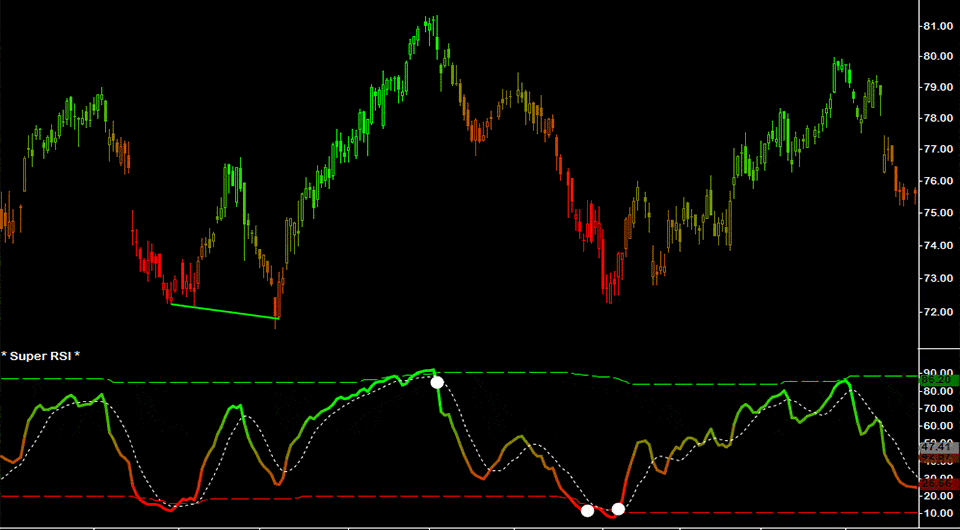
Bearish divergence occurs when price makes a new high but the RSI makes a lower high, thus failing to confirm. Bullish divergence occurs when price makes a new low but RSI makes a higher low.

How to calculate RSI? 

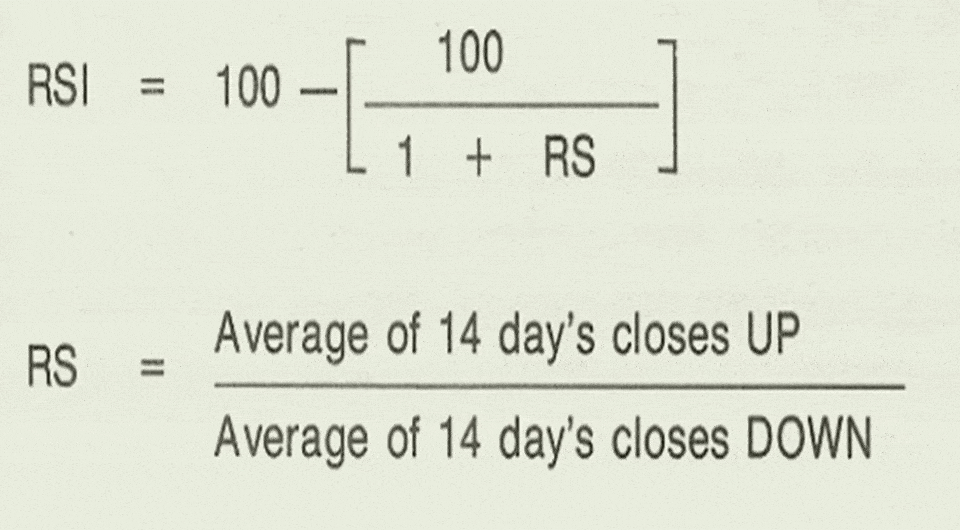
The smoothed moving averages should be appropriately initialized with a simple moving average.

How does RSI help in trading? 

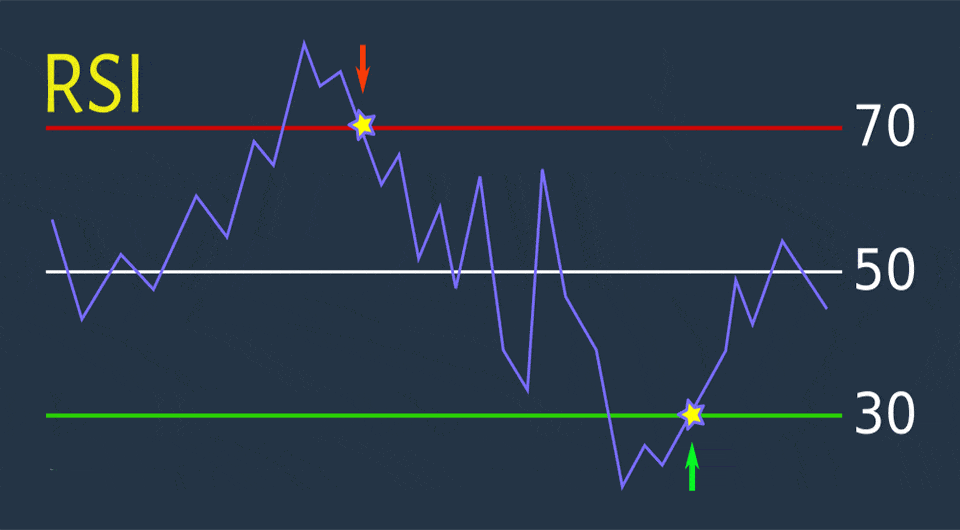
The price oscillates between 0 and 100, traditionally the RSI is considered overbought when above 70 and over sold when below 30.

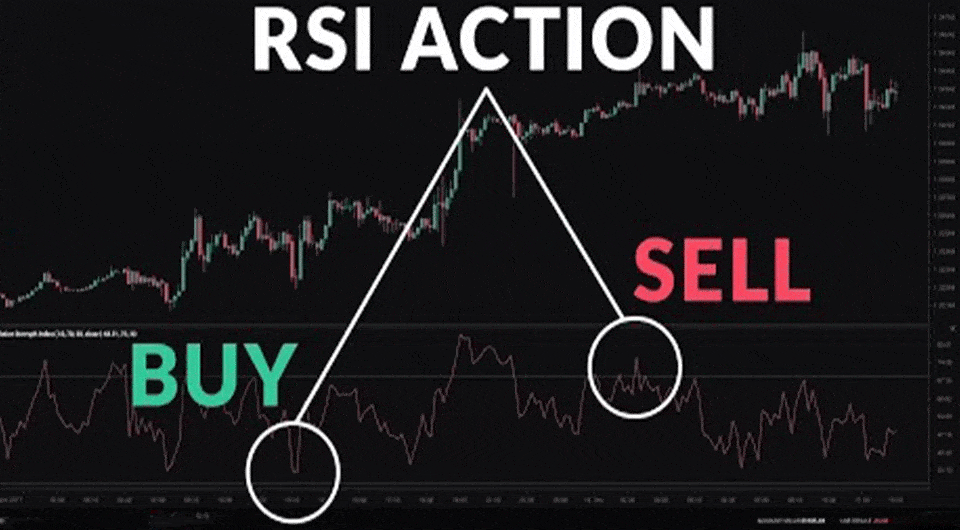
  When indicators start going above 70, then it’s called the market overbought, and it signals for the sell.

   When indicators start going below 30 , then it’s called the market oversold, and it’s a signal for buy.

Uptrend and downtrends:

(1)RSI Bullish-indicators survive in the range of 50-100.

(2)RSI bearish-indicators survive in the range of 0-50.

(3)RSI sideways-when indicators survive around 50,minor momentum

  Indicators pattern-double top and bottom double:

Whenever an indicator creates a double top in the range of 70-100,then is the signal of strong reversal.

Whenever an indicator creates a double bottom in the range of 0-30,then is the signal of a strong reversal.

Continue reading

Five Tips to Improve Your Stock Trading Mindset

Stock Trading Mindset TipsYou need to have a certain quality and have the right mentality to become an expert in stock trading. You not only need to overcome nature-to learn about stock trading, but you also need to overcome yourself-to overcome innate psychological obstacles such as deep-rooted fear, hope and greed, and gradually develop the right attitude.

So, what is the right mindset to improve stock trading? Follow these five steps to win:

Continue reading

8 Tips to Manage Your Small Business Effectively

manage small businessEvery business owner wants to be successful. Properly managing your business and finances is a key to business success. For massive growth and higher productivity, your business should be well-organized. Check out the top ways that can transform your office into an efficient workplace: Continue reading

Identifying multibagger stocks for SIP

A mutual fund house selects many stocks from different sectors and multibaggercreates a balanced portfolio. This diversification helps mitigating risk, but it also polarizes your funds. Once a sector gets hit, the total fund value comes down. You cannot choose to shift away from these stocks and have to wait till it gets better. It is always wise to select a bunch of stocks yourself and bet regularly. There are more than, 7000 stocks in BSE & NSE combined. It is like searching a drop in an ocean, tedious but possible. There are several factors on which a stock is screened before qualifying it as a potential multibagger. Given the technological tools we have today, it is a lot easier than it was a decade back. Before searching for a multibagger we must first decide on our risk capacity.

Ask yourself two questions:
How much can I save from my monthly income?
How much can I save from my monthly expenses?

Spend more time on the second question. Make no mistake, I am not asking you to decrease expenses. Just add a little more to your expense each and every time you spend. In other words, tax yourself. Transfer a percentage of the total expense to your trading account (call it an iTax, myTax or whatever you wish) but do it for every transaction you do. It might sound crazy, but believe me, it works wonders! You can either invest this taxed amount in certain stocks or use it as a risk manager when your stock trades lower than previous highs.

Now let’s search for the drop. Our ocean is made of different sectors and all these sectors are dependent on each other in one-way or other. There is no fool-proof way to find an ever bullish sector. Instead, find a visible problem the world is facing today and the sector which is directly related to solving the problem. For example, pollution is an alarming issue throughout the world, and it is only getting worse day by day. Many governments have already started taking steps to control pollution in every possible way. Hence, we can find a stock which deals with pollution control. On the same lines is cybersecurity. Every business is online and all need to be safe. Companies which offer cybersecurity are going to be in demand, hopefully, in the near future. Next challenge will be to square in on a stock in this sector. That is where fundamentals of a company come in handy. Look at few important factors like Market Cap, Book value, P/E vs Industry P/E and Dividend yield. Check the financial trend of the company. Many growing companies report negative net profit but their net sales might still be increasing which is a positive sign. Above all, this is the credibility of promoter group; make sure you have read their activities in the market. Continue reading

Benefits of Systematic Investment Plan (SIP)

“Disciplined investors built their own empire, others just made money”

systematic investment plans

Stock markets are for the rich, who can throw their money at anything and wait for a bigger fortune. This is the biggest myth I have ever heard, and also the most common myth among retail investors. In the hindsight, this is the only place where millionaires are made from nowhere. All you need to do is to follow few strategies and stick to a discipline. Among many investment strategies in the stock market, Systematic Investment Plan (SIP) stands out to be the least complicated one. Investing in SIP is like learning to swim. The earlier you invest, the greater your returns in the long run. There are two ways to invest in SIP. Either you choose a mutual fund available in the market or you can choose few stocks yourself and keep investing. It is like paying Pre-EMI. When you buy something and pay EMI, you are actually paying an interest to the bank, thereby increasing the cost of the product you bought. The bank decides the interest and the EMI. Longer the duration, higher is the interest. You cannot skip an EMI and have to pay it on the specified date.  If you wish to… close in-between, you will have to pay a penalty. The interest rate fluctuates depending on the market condition.

Continue reading