In 2013, EURUSD Can Target 1.36 – 1.44
The pro-growth monetary policy should mildly support economies throughout the world in 2013, despite the persistence of different risk factors. The US dollar may decline further. What will happen to stocks and bonds?
US dollar: More declines ahead
The EURUSD played a starring role during the last part of 2012. This uptrend, which started in July after President Draghi declared the European Central Bank’s (ECB) willingness to buy unlimited bonds, is still ongoing. The market is meeting an important resistance at 1.33 and corrections are therefore possible. Uncertainty exists regarding Italy’s capability of forming a meaningful government after the political elections next year in February. However, the medium-term uptrend remains intact for the Euro against the US dollar. The ECB should not cut rates short-term, as the economy, though weak, is improving. The latest Purchasing Manager’s Index (PMIsurvey signaled that productivity has bottomed out and should start to rise over the medium-term. The ECB’s “wait and see” approach can support the Euro to reach higher levels. Since 1977, bull-moves within long-term bull cycles have lasted between 20% and 30%, top to bottom, before fading away. Consequently, an increase above 1.3350 can raise the price of the euro to 1.36, and eventually to 1.44.
Although Japan is in recession, Japanese housing starts, industrial production, and consumer sentiment have recently been positive. Prime Minister Abe has become more accommodative in his tone toward the economy. The Japanese yen could experience less pressure in the months ahead. Currently, USDJPY is experiencing a runaway bull-trend and is meeting good resistance at 84.55. It corresponds to two long-term trendlines and should hold at first touch. The US dollar is in fact extremely overbought and could correct to 83.00. According to the latest Commitment of Traders (COT) report, futures funds have bought massive amounts of the US dollar; a move above 85.10 will shift the price to 86.20/87.00
Will bond prices fall and stock prices rise?
The debate in Congress over the “fiscal cliff” is ongoing. A compromise could be found by the first part of 2013. As risk continues to fade, the US treasury yields should move toward 2.00%. The Federal Reserve is willing to let inflation expand in order to create positive momentum in the job market. Technically, the US ten-year note prices are leaning against the upper channel line of the past 26 years. A tentative breakout occurred in July and has apparently failed. In fact, the market is extremely overbought. According to the latest COT report, future funds have accumulated about 400,000 contracts of the ten-year treasury notes, the highest level in the past four years. What is left to buy if most of the major players are already in the market? In 2013, the prices of the ten-year notes futures could decline for 3-6 months and reach 132-130.
With bond yields rising and the dollar declining, US stocks should appreciate in the first part of 2013 as well. US company earnings are still performing well, while profit margins should improve with the labor market only mildly growing. The Fed’s pro-growth approach is supporting prices, and once Operation Twist concludes, it will be followed by net bond buying. Technically, the S&P 500 index is challenging the higher Bollinger bands at 1450. A swing above 1475 could lift prices to 1500/1550. Historically, January is a good month for stocks. Volatility could increase, however, if a compromise is not found in the short-term. During the last part of 2012, US companies and households have already reduced spending. The business sector can increase production only if foreign demand rises faster in 2013 than in 2012. The latest data has shown that China’s economy is growing again, but other so called “emerging markets” are still underperforming. A recession in the US will destabilize the world’s still fragile economic recovery.
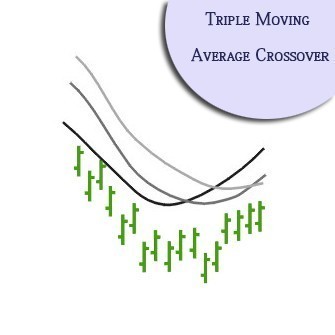
Triple Moving Average Crossover
This is the 18th Day course in a series of 60-Days called “Technical Analysis Training”
You will get daily one series of this Training after 8 o’clock night (Dinner Finished)
Follow MoneyMunch.com Technical Analysis Directory and Learn Basic Education of Technical Analysis on the Indian Stock Market (NSE/BSE)

Triple Moving Average Crossover
Effect of Triple M.A.
When a shorter moving average (of a security’s price) crosses a moderate moving average, as well as the medium crosses a longer moving average, a bullish or bearish signal is produced this depends on the way of the crossovers.
Story
A moving average is an indicator that concerts the average worth of a security’s price more than a period of time. This excellent type of event occurs whenever a shorter moving average crosses a moderate moving average, and also the medium moving average crosses a longer moving average. The moving average times used in the celebration are really 4, 9 and 18 day. Whenever the 4-day crosses above/below the 9-day moving average, the event possess “started”. The celebration is “confirmed” whenever 9-day moving average crosses above/below the 18-day moving average.
A bullish signal is produced once the direction of the crossovers is above e.g. the shorter crosses above the moderate plus the moderate crosses above the longer. A bearish alert is generated whenever the movement of the crossovers is below.
These games are really based on top of straight forward moving averages. A straight forward moving average is certainly one just where equal weight is taking into account to any single price around the calculation period. For instance, a 9-day straight forward moving average is calculated if you take the sum of the very last 9 days of a stock’s close price and additionally then separating by 9. Other kinds of moving averages, that are not supported in this case, are really weighted averages and additionally exponentially smoothed averages.

Trading Factors
Moving averages are lagging indicators because they use ancient information. Making use of them because indicators will likely not get you in during the bottom and also away during the top but can get you in and additionally out somewhere between.
The couple work ideal in trending price designs, in which a good uptrend or downtrend is strongly in place.
Factors that Supports
Indicators that are fine appropriate to using moving averages consist of the MACD and Momentum.
Main Behavior
Moving averages flourish in trending markets even so they generate numerous false signals in choppy, sideways markets.
Message for you(Trader/Investor): Google has the answers to most all of your questions, after exploring Google if you still have thoughts or questions my Email is open 24/7. Each week you will receive your Course Materials. You can print it and highlight for your Technical Analysis Training.
Wishing you a wonderful learning experience and the continued desire to grow your knowledge. Education is an essential part of living wisely and the Experiences of life, I hope you make it fun.
Learning how to profit in the Stock Market requires time and unfortunately mistakes which are called losses. Why not be profitable while you are learning?
The Fiscal Cliff Explained
“Fiscal cliff” is the popular shorthand term used to describe the conundrum that the U.S. government will face at the end of 2012, when the terms of the Budget Control Act of 2011 are scheduled to go into effect.
Among the laws set to change at midnight on December 31, 2012, are the end of last year’s temporary payroll tax cuts (resulting in a 2% tax increase for workers), the end of certain tax breaks for businesses, shifts in the alternative minimum tax that would take a larger bite, the end of the tax cuts from 2001-2003, and the beginning of taxes related to President Obama’s health care law. At the same time, the spending cuts agreed upon as part of the debt ceiling deal of 2011 will begin to go into effect. According to Barron’s, over 1,000 government programs – including the defense budget and Medicare are in line for “deep, automatic cuts.”
In dealing with the fiscal cliff, U.S. lawmakers have a choice among three options, none of which are particularly attractive:
They can let the current policy scheduled for the beginning of 2013 – which features a number of tax increases and spending cuts that are expected to weigh heavily on growth and possibly drive the economy back into a recession – go into effect. The plus side: the deficit, as a percentage of GDP, would be cut in half.
They can cancel some or all of the scheduled tax increases and spending cuts, which would add to the deficit and increase the odds that the United States could face a crisis similar to that which is occurring in Europe. The flip side of this, of course, is that the United States’ debt will continue to grow.
They could take a middle course, opting for an approach that would address the budget issues to a limited extent, but that would have a more modest impact on growth.
Can a Compromise be Reached?
The oncoming fiscal cliff is a concern for investors since the highly partisan nature of the current political environment could make a compromise difficult to reach. This problem isn’t new, after all: lawmakers have had over a year to address this issue, but Congress – mired in political gridlock – has largely put off the search for a solution rather than seeking to solve the problem directly. Republicans want to cut spending and avoid raising taxes, while Democrats are looking for a combination of spending cuts and tax increases. Although both parties want to avoid the fiscal cliff, compromise is seen as being difficult to achieve – particularly in an election year. There’s a strong possibility that Congress won’t act until the eleventh hour. Another potential obstacle is that the next Congress won’t be sworn in until January 3, after the deadline.
The most likely outcome is another set of stop-gap measures that would delay a more permanent policy change until 2013 or later. Still, the non-partisan Congressional Budget Office (CBO) estimates that if Congress takes the middle ground – extending the Bush-era tax cuts but cancelling the automatic spending cuts – the result, in the short term, would be modest growth but no major economic hit.
Possible Effects of the Fiscal Cliff
If the current laws slated for 2013 go into effect, the impact on the economy would be dramatic. While the combination of higher taxes and spending cuts would reduce the deficit by an estimated $560 billion, the CBO estimates that the policies set to go into effect would cut gross domestic product (GDP) by four percentage points in 2013, sending the economy into a recession (i.e., negative growth). At the same time, it predicts unemployment would rise by almost a full percentage point, with a loss of about two million jobs. A Wall St. Journal article from May 16, 2012 estimates the following impact in dollar terms: “In all, according to an analysis by J.P. Morgan economist Michael Feroli, $280 billion would be pulled out of the economy by the sunsetting of the Bush tax cuts; $125 billion from the expiration of the Obama payroll-tax holiday; $40 billion from the expiration of emergency unemployment benefits; and $98 billion from Budget Control Act spending cuts. In all, the tax increases and spending cuts make up about 3.5% of GDP, with the Bush tax cuts making up about half of that, according to the J.P. Morgan report.” Amid an already-fragile recovery and elevated unemployment, the economy is not in a position to avoid this type of shock.
The cost of indecision is likely to have an effect on the economy before 2013 even begins. The CBO anticipates that a lack of resolution will cause households and businesses to begin changing their spending in anticipation of the changes, possible reducing GDP before 2012 is even over.

How Banks Make Money
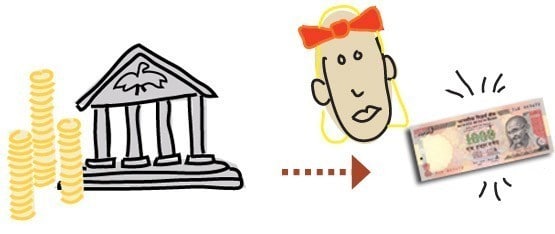
Yes, the government prints our businesses paper money. But thats just a little small fraction of the money in use. Most of the funds in state economies is made when banks write it directly into their customers’ accounts as a result of thin air as bank loans.

This is the “reserve,” which the bank uses when customers withdraw funds. As a rule, depositors don’t take out more than 10% of the money they have on deposit on any given day.
See how it all adds up—for the banks.
You now have Rs,10,000 in your account. Susie has Rs.9,000 in hers. Joe has Rs.8,100.
There’s now Rs.27,100 total in accounts that you and Susie and Joe can spend, and it all came from your Rs.10,000 deposit. The banks have created an additional Rs17,100 by loaning it into existence.
Mad math: If those loans are for one year at 10% interest, the banks will make Rs.8800.53. If they’d only been able to loan your Rs.10,000, they’d make Rs.1000.
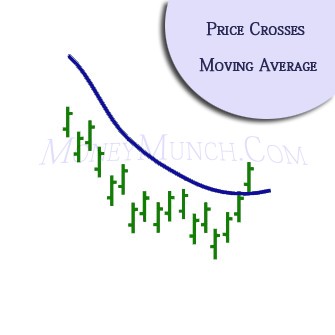
Price Crosses Moving Average
“Technical Analysis Training”
This is the 17th Day course in a series of 60-Days called “Technical Analysis Training”
You will get daily one series of this Training after 8 o’clock night (Dinner Finished)
Follow MoneyMunch.com Technical Analysis Directory and Learn Basic Education of Technical Analysis on the Indian Stock Market (NSE/BSE)
Price Crosses Moving Average
Effect of Price Crosses M.A.
When a security’s price crosses it is moving average (the event), a bullish or bearish alert is produced according to the direction of the crossover.
Story
A moving average is definitely an indicator which performances the average worth of a security’s price over a time period. This kind of Technical Researching happens whenever the price crosses a moving average. Three moving averages are really supported: 21, 50 and additionally 200 days. A price cross of the longer moving average indicates a longer term signal, since the safety might take a longer period of time to move within the anticipated direction.
A bullish alert is produced when the security’s price rises above it is moving average as well as a bearish alert is produced once the security’s price falls below it is moving average.
These events are really based on straight forward moving averages. A simple moving average is one where equal body weight is bearing in mind to any single price around the calculation period. For example, a 21-day simple moving average is calculated if you take the sum of the final 21 days of the stock’s close price and also then separating by 21. Different kinds of moving averages, that are not supported here, are really weighted averages and also exponentially smoothed averages.

Trading Factors
- Moving averages are really lagging indicators because the couple utilize historic information. Using them since indicators is not going to get an individual in at the bottom and additionally away during the top however can get an individual in and additionally out someplace between.
- They work ideal in trending price designs, where some kind of uptrend or downtrend is strongly put in place.
- In trending markets, moving averages can provide a simple and also effective approach to identifying styles.
- Moving averages also work as support areas. An individual will often see an extra stock in one uptrend advancement well above its 21 day moving average, return to it and additionally then advancement once again.
- Moving averages additionally become resistance areas. When an extra stock investments under a moving average, which average can provide since a resistance price and additionally it is difficult for the extra stock to move above it. This really is frequently really real when an extra stock has fallen below its 200 day moving average.
Factors that Supports
Indicators which are fine appropriate to using moving averages consist of the MACD and also Momentum.
Main Behavior
Moving averages do well in trending markets even so they generate numerous false signals in choppy, sideways markets.
Message for you(Trader/Investor): Google has the answers to most all of your questions, after exploring Google if you still have thoughts or questions my Email is open 24/7. Each week you will receive your Course Materials. You can print it and highlight for your Technical Analysis Training.
Wishing you a wonderful learning experience and the continued desire to grow your knowledge. Education is an essential part of living wisely and the Experiences of life, I hope you make it fun.
Learning how to profit in the Stock Market requires time and unfortunately mistakes which are called losses. Why not be profitable while you are learning?

Unlock This Article