Get free share market NSE & BSE stocks, cash equity, futures, options, and all nifty trading tips and market research reports that enhance your knowledge and take your trading game to the next level.
PEL has formed a double three corrective structure. Price had completed wave B of complex correction W-X-Y.
As the price formed in the downward channel and the Y wave was to cease, the price had bearish sentiments.
I had mentioned in clear words,” Traders can initiate short positions for the following targets:2400 – 2376 – 2301 – 2279.”
After:
8 February:
Price reached the first target of 2400 and made a low of 2996.
14 February:
Price reached the 2nd target at 2376.
Price reached the 3rd target at 2301.
Price reached the 4th target at 2279.
Unlock This Article
Only subscribers can read the full article. Please login to read the entire article.
GPIL: Godawari Power
Before:
PEL has formed a downward corrective structure. Price was at the upper band of the parallel channel.
The upper-band indicates supply pressure where sellers exceed buyers.
The price has provided two successful rejections from the upper band.
GPIL had bearish the sentiments.
I had mentioned in clear words,” The trader can initiate a short position for the following targets: 313 – 304 – 290.”
After:
At the upper band, the price couldn’t break the upper band of the parallel channel.
14 February: GPIL reached the First target of 313.
15 February: GPIL reached the second target of 304.
What’s next?
Price is at the lower band of the parallel channel. And if the price breaks down the minor parallel channel, it can travel up to the control line of the downward channel.
To become a subscriber, subscribe to our free newsletter services. Our service is free for all.
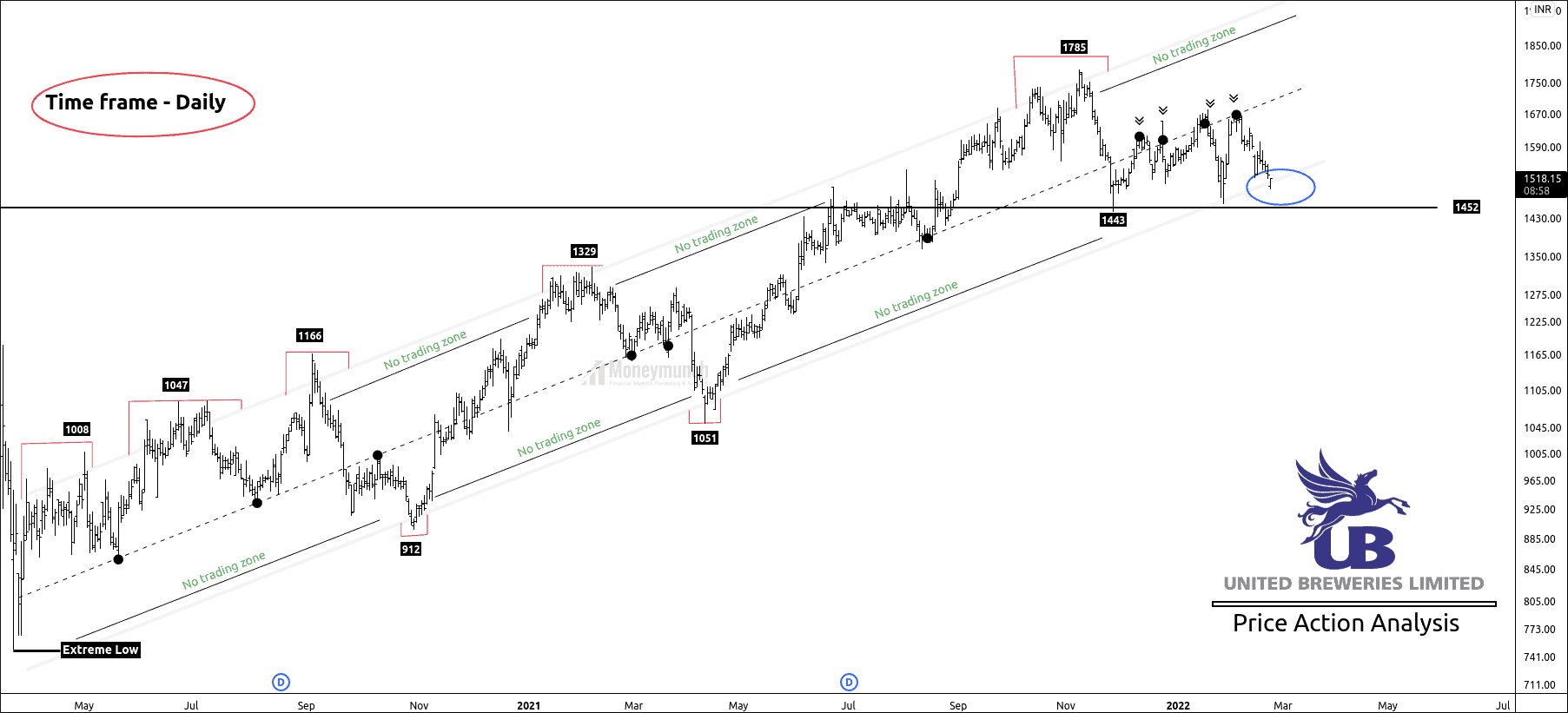
Alright, the operation started after creating an extreme low at 120.20. Price has created an upward channel from the extreme low, where the equilibrium has occurred between bull and bear traders. Control line has given eleven touches, which shows the strong gravitation at the middle.
Here, we can see four reversals on the upper band, and three reversal points occurred on the lower band.
We have two opportunities:
1. Now, the price is on the H-line, and the breakout of the h line indicates the lower band touch.
2. Bull can buy at excess, or they can enter at reappearing in the value area for the target of the control line.
Every beginner who wants to start trading with naked strategy (without indicator) can use this method because the price is the thing that will pay you. Let me explain to you important aspects of the breakdown strategy.
Value area:
A zone in which bulls and bears both are satisfied to stay within it. In this zone, supply and demand equally exist.
Value area has two bands:
1. Upper band
2. Lower band
Ascending Value area:
Range-Bound Value area:
Descending Value Area:
Upper band:
Upper band indicates demand-supply. In this chart, the price has taken four reversals from the upper band to maintain the equilibrium. The upper band put a stop to the bull power.
Lower Band: The lower band indicates demand pressure. In this chart, the price has taken three reversals from the lower-band to maintain the equilibrium. The lower band put a stop to bear power.
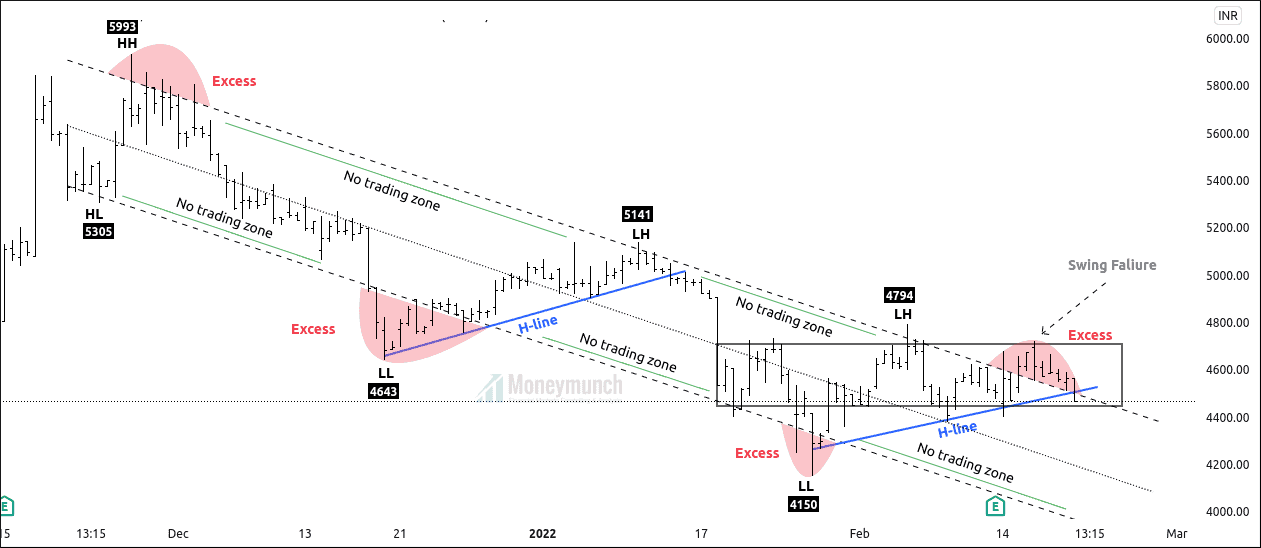
No trading zone: In order to respond to either bull or bear’s initiative, the price creates an area. In which no trading activities have taken. It helps to find the weakness of any particular move.
H Line. After completing the last share move, the price creates the bulk trading activities, where bulls’ power becomes dull. Breakout of the H-line indicates the cease of the particular move.
Excess:
Excess is regret and fake-out.
In simple words, price breaks the upper band and again re-enter into the parallel channel. Buying or selling at the excess is the perfect deal.
An excess is a signal of reversal.
The psychology behind the control line: Price is forming in the parallel channel, but bulls are not satisfied with the current trend. That’s why bulls increase demand pressure to break the upper band of the value area. After breaking the upper band, bulls face some problems with profit booking. Now, bulls realize that the price is not going up. Bulls give up on the thought of trend change. Bears were watching this patiently. And after they realize that prices are too high, they increase supply pressure above the upper band of the channel. Now bulls are out of the market, and the seller has maintained the equilibrium & Vice versa.
Control line:
The Control line is the gravitation point of any value area. We can draw by connecting the reversal points in the middle. The more the points are available, the higher the effectiveness.
Please note that the price can not stay away from the control line of the value area. We can use it as a price target or breakout trade.
Here, the price has given eleven touches on the control line.
Breakout or breakdown of the channel: Bulls and bears both disagree with the current price trend. Either bulls or breaks out the value area by giving consistent closing. It often happens after a complex correction or trend change.
Unlock This Article
Only subscribers can read the full article. Please login to read the entire article.
To become a subscriber, subscribe to our free newsletter services. Our service is free for all.
Today, I’m talking about real-time “Barrier Triangles” which developing on BPCLand very specific aspect of this triangle that I’ve encountered numerous times and that’s the frustrating aspect or characteristic of a triangle stuff to sometimes. In this instance, we are looking at a triangle where we actually have a triangle within triangle.
Let me explain you my price chart over real quick, and you’ll see exactly what I’m talking about. Notice we have connected by trend line waves A and C is horizontal and waves B and D sloping downward therefore, we reveal barrier triangle.
Breakdown – 357 expecting more fall. Resistance – at or nearby 419
But here, lower TF research can increase odds and confident for trade setup.
I will shortly update – lower TF here.
To become a subscriber, subscribe to our free newsletter services. Our service is free for all.
Abbott India has accomplished the impulsive wave 3, and the price is forming corrective wave 4. Price has occurred the sub-wave A. and Sub-wave B. Sub-wave C of 4th wave is in progress.
After completion of wave 4, the price will start its bull run.
Fibonacci relationship and wave Formations:
Wave ((1)) is a five-wave impulse.
Wave ((2)) retraced 50% of wave ((1)). Wave ((2)) has taken 23 months to finalize.
Wave ((3)) is a five-wave impulse.
Wave ((4)) looks like a sharp correction.
Rule of alternation indicates variation between two corrective waves in terms of time, distance, and formation.
Because wave ((2)) was a complex correction, wave ((4)) should be a sharp correction.
Destiny of wave ((4)):
Wave ((4)) can terminate near the previous corrective wave (iv) at 13994.
Wave 4 can end at, 15064, which is a crucial support level.
The common retracement of wave ((4)) is 38.2%, but the price has broken down to this level. Next Fibonacci retracement level is 50% at, 13967.
Please note that the corrective channel has broken down, so bulls can enter when the price renter into the parallel lines. Otherwise, the price has bearish sentiments.
To become a subscriber, subscribe to our free newsletter services. Our service is free for all.
Unlock This Article
Only subscribers can read the full article. Please login to read the entire article.