The Moneymunch editorial staff is a team of experienced financial writers and analysts with over a decade of experience in the financial markets. They have previously contributed to popular financial blogs and newspapers, and are passionate about providing accurate and up-to-date information to help both investors and traders make informed decisions. Trust the Moneymunch editorial staff to provide reliable and effective financial advice that can help you achieve your financial goals.
Index Nifty: This is the List of Stocks included in the S&P CNX NSE Nifty, Nifty movement is depend on this stocks. The stocks which are included in the composition of the NSE Nifty 50 are changed on certain event. So it’s called as index nifty.
24 Jindal Steel & Power Ltd. 25 Kotak Mahindra Bank Ltd.
26 Larsen & Toubro Ltd.
27 Mahindra & Mahindra Ltd. 28 Maruti Suzuki India Ltd.
29 NTPC Ltd.
30 Oil & Natural Gas Corporation Ltd.
31 Power Grid Corporation of India Ltd.
32 Punjab National Bank 33 Ranbaxy Laboratories Ltd.
34 Reliance Capital Ltd.
35 Reliance Communications Ltd.
36 Reliance Industries Ltd.
37 Reliance Infrastructure Ltd.
38 Reliance Power Ltd.
39 Siemens Ltd.
40 State Bank of India
41 Steel Authority of India Ltd.
42 Sterlite Industries (India) Ltd.
43 Sun Pharmaceutical Industries Ltd.
44 Suzlon Energy Ltd.
45 Tata Consultancy Services Ltd.
46 Tata Motors Ltd.
47 Tata Power Co. Ltd.
48 Tata Steel Ltd.
49 Unitech Ltd.
50 Wipro Ltd.
Get free important share market ideas on stocks & nifty tips chart setups, analysis for the upcoming session, and more by joining the below link: Stock Tips
Have you any questions/feedback about this article? Please leave your queries in the comment box for answers.
Disclaimer: The information provided on this website, including but not limited to stock, commodity, and forex trading tips, technical analysis, and research reports, is solely for educational and informational purposes. It should not be considered as financial advice or a recommendation to engage in any trading activity. Trading in stocks, commodities, and forex involves substantial risks, and you should carefully consider your financial situation and consult with a professional advisor before making any trading decisions. Moneymunch.com and its authors do not guarantee the accuracy, completeness, or reliability of the information provided, and shall not be held responsible for any losses or damages incurred as a result of using or relying on such information. Trading in the financial markets is subject to market risks, and past performance is not indicative of future results. By accessing and using this website, you acknowledge and agree to the terms of this disclaimer.
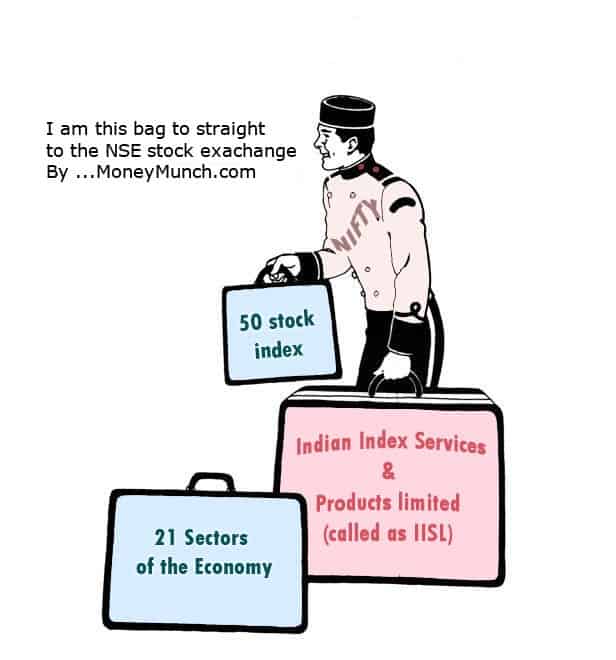
Nifty Index Definition: S&P CNX Nifty is varied 50 Stock Index construction for 21 sectors of the economy. It is utilized for a variety of purposes like benchmarking fund portfolios, index based derivatives and index funds. Nifty Index is relating to NSE Stock Exchange, Sensex Sensex is for BSE Stock Exchange.
Indian Index Services & Products limited(also known as IISL) owns NIFTY. ISSL is a joint project of NSE & CRISIL. But CRISIL is a subsidiary of standard and Poor, which labeled as S&P NIFTY or, S&P CNX NIFTY.
The traded value due to the last six months of all Nifty stocks is around 44.89% of the traded value of all stocks on the NSE
Nifty stocks express about 58.64% of the total market exploitation as on March 31, 2008.
Impact cost of the S&P CNX Nifty for a portfolio size of Rs.2 crore is 0.15%
S&P CNX Nifty is professionally managed and is perfect for derivatives trading.
Above information is what is the definition of nifty…
Get free important share market ideas on stocks & nifty tips chart setups, analysis for the upcoming session, and more by joining the below link: Stock Tips
Have you any questions/feedback about this article? Please leave your queries in the comment box for answers.
Disclaimer: The information provided on this website, including but not limited to stock, commodity, and forex trading tips, technical analysis, and research reports, is solely for educational and informational purposes. It should not be considered as financial advice or a recommendation to engage in any trading activity. Trading in stocks, commodities, and forex involves substantial risks, and you should carefully consider your financial situation and consult with a professional advisor before making any trading decisions. Moneymunch.com and its authors do not guarantee the accuracy, completeness, or reliability of the information provided, and shall not be held responsible for any losses or damages incurred as a result of using or relying on such information. Trading in the financial markets is subject to market risks, and past performance is not indicative of future results. By accessing and using this website, you acknowledge and agree to the terms of this disclaimer.
Your time is most valuable, and so you should not waste it. You should not waste time in wasteful thoughts. Every second of yours is as valuable as a diamond.
In fact, I’d bet that deep down you know you should be following these rules as well but you aren’t – yet. Today is the day you can commit to doing what works for other wealthy traders and get on that same path.
Let’s get started.
1. They plan every single trade. EVERY SINGLE ONE.
Every trader I’ve talked with that makes money consistently knows the following about every single trade they take before they even begin entering a limit order into their trading platform:
The highest price they are willing to pay (if they are going long) or the lowest price at which they are willing to sell (if they are going short)
Their profit target where they will exit if they are “right”
The exact percentage of their account they are risking
Lots of traders do one or two of these things. Few do all of them. In simple terms they know exactly what they want to pay, how much money they anticipate making (or losing) and a very clear idea on the probability of the trade working out.
Although you might think that every great trader uses hard stops that are pre-programmed in, many don’t . However, they are highly disciplined and when their stop loss number comes up they are out. Most traders don’t have that type of hard-core discipline and so a hard stop loss is still their best option.
2. They stopped trying to pick tops and bottoms years ago
Nearly all of the classes, courses and webinars you’ll find on the Internet talk about using support and resistance of some type to find where a market is turning and how to get in before or while it does.
The funny thing is that only a very few successful traders I have ever talked to trade that way. Simply put, 95% of the traders out there that make money are buying higher highs and selling lower lows. They do the exact opposite of nearly everyone out there because they found out long ago that picking tops and bottoms is a sucker’s bet. One trader described it to me by saying that it’s much easier to just participate in what a market is already doing than trying to guess when that behavior will change. Flip-flop your strategy to agree with what the market is doing rather than guessing on when it will change its mind, and you’ll be in a much better position to make money trading.
3. They are patient with winners – and ridiculously impatient with losers.
Dennis Gartman is famous for boiling down great trading to one thing: “Do more of what is working and less of what isn’t.” Sure makes a lot of sense to me.Most traders have a great deal of patience with their losers but get nervous about locking in gains and sell them to quickly – the exact opposite of what wealthy traders do. Wealthy traders realize that they may actually have more losing trades than winning trades so they quickly get out when they are wrong. It is the only way to ensure that they can give their winners the attention they deserve.
They coddle their winners and kick their losers to the curb without a second thought.
4. They trade one market. ONE
I’ve talked with great traders who can trade futures, forex and stocks at the same time. They are a gifted tiny minority.
The vast majority of successful traders concentrate on one market and become so comfortable with it that they begin to “know” the behavior of that market just watching price and volume. Test yourself – if you aren’t able to get rid of all your charts and simply look at price and volume to trade, you’re probably not concentrating enough on one market in order to know its moods. What we’re really talking about here, of course, is not the mood of the market itself but the moods of the market participants!
Focus on trading one market exceptionally well rather than try to trade whatever’s hot – that’s how wealthy traders do it.
5. Their benchmark for success is anything but money
Money changes everything. It sure does. We’re all in this to make money. The trouble is, when traders use the amount of money they make to judge their own success, something happens to them – to all of us, really – that clouds our decision-making ability.
Wealthy traders have realized this and instead focus on other things to determine if they’ve had a successful day. Whether it be how well they were able to execute on their trading plan (see rule #1), or their overall ability to predict short-term movements in whatever they are trading, they know that if they do those things correctly, the money will follow.
Yes of course the money is important. Any trader who says otherwise is a fool. Why else would we put ourselves through this daily ride. But there is something about making it a secondary focus that allows the best traders to make better decisions. The growing trading account simply becomes a nice result – a side benefit if you will – of making good decisions and reading the market well.
Death is inescapable, there is no way to escape from it. Similarly, you can’t run away from few kinds of Debts – and these debts are like “once a person is owing money, and die; someone has to pay for it”. For example co-singers who sign onto student loans are held accountable for the money being loaned to be paid back as well.
This infographic from Total Bankruptcy tells you the same story with many angles – it can help you to have an idea about what happens to your debt when you die.