

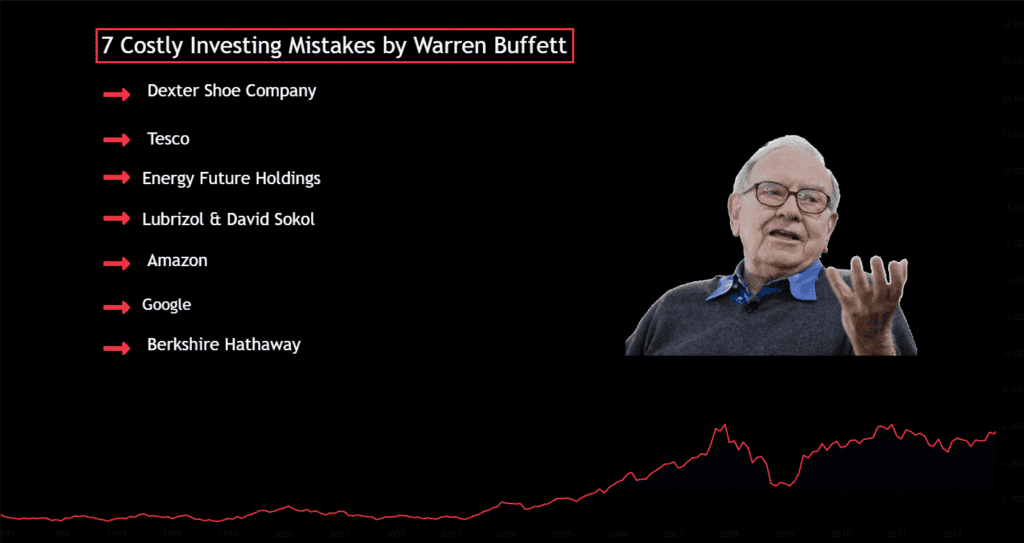

Warren Buffett’s name is synonymous with long-term investing success. Through Berkshire Hathaway, he built massive positions in iconic companies like Coca-Cola, American Express, Apple, Bank of America, Moody’s, and Kraft Heinz, eventually becoming one of the richest individuals in the world with a net worth exceeding USD 100 billion.
What sets Buffett apart isn’t just his wealth; it’s his willingness to publicly admit his mistakes and share the lessons behind them. One of his most quoted beliefs is that it’s far better to learn from others’ mistakes than to make them yourself. Ironically, some of the best investing lessons ever taught come from Buffett’s own errors.
Warren Buffett’s 7 Major Investment Mistakes
1. Dexter Shoe Company
In 1993, Berkshire Hathaway acquired Dexter Shoe Company in what Buffett later called his worst deal ever. The core mistake was failing to recognize that Dexter lacked a durable competitive advantage. While the company showed strong returns at the time, Buffett underestimated the long-term impact of cheap imports from countries like China, which eventually crushed U.S. shoe manufacturers.
The second and far more costly mistake was paying for the acquisition using Berkshire Hathaway stock instead of cash. What was worth USD 433 million at the time ultimately translated into a loss of roughly USD 15 billion in shareholder value as Berkshire stock compounded over decades.
Lesson: Never underestimate competitive threats, and never trade a compounding asset for a business with an uncertain future
2. Tesco
Berkshire’s investment in Tesco began to unravel around 2012 as competition intensified and warning signs emerged. Despite recognizing these red flags, Buffett hesitated to exit the position. When accounting irregularities surfaced and sales weakened, Tesco’s stock collapsed, resulting in a loss of approximately USD 444 million for Berkshire.
Lesson: Conviction matters on both sides. If the original investment thesis breaks, holding on is not discipline, it’s denial.
3. Energy Future Holdings
Buffett invested USD 2.1 billion in the bonds of Energy Future Holdings, betting that rising natural gas prices would support the company’s coal-based operations. Instead, gas prices collapsed, the company filed for bankruptcy in 2014, and Berkshire exited with a loss of USD 873 million.
Buffett later admitted that he misjudged the probability of success and failed to adequately stress-test the downside.
Lesson: Predicting commodity prices is a dangerous game, and high-yield bonds can devastate capital when assumptions fail, especially for retail investors who lack Buffett’s margin for error.
4. Lubrizol and David Sokol
In 2011, Berkshire acquired Lubrizol for about USD 9 billion after it was recommended by senior executive David Sokol, who failed to disclose that he personally owned shares in the company. Sokol later profited from the deal, triggering a major governance scandal.
While the acquisition itself was financially sound, the episode exposed weaknesses in internal controls and oversight.
Lesson: Trust is not a strategy. Even the best organizations need strict processes, transparency, and accountability, especially when reputations are at stake.
5. Amazon (Missed Opportunity)
Not all mistakes involve losing money. Some involve not investing at all.
Buffett openly admitted that he followed Amazon for years but never bought the stock because he underestimated Jeff Bezos and struggled to value the business under his traditional framework. He failed to fully grasp Amazon’s dominance in both e-commerce and cloud computing through AWS.
Lesson: Staying within your circle of competence is wise, but refusing to expand it is costly.
6. Google (Alphabet)
Berkshire never invested in Google, despite its relevance being obvious through GEICO, which heavily relies on Google’s advertising platform. Buffett later acknowledged that he should have studied the business more deeply and that his lack of technical understanding contributed to the miss.
Lesson: Proximity to a great business is meaningless if you don’t take the time to understand it.
7. Berkshire Hathaway Itself
Buffett’s most ironic mistake was buying Berkshire Hathaway in the first place. Initially, it was a struggling textile company purchased under Benjamin Graham’s “cigar-butt” investing philosophy. What began as a value play turned into an emotional decision after Buffett felt insulted by a lowball buyback offer.
He held the failing textile business for two decades, later admitting that redirecting that capital into better businesses. Like insurance, would have doubled Berkshire’s value.
Buffett estimates this decision cost shareholders over USD 200 billion in missed potential.
Lesson: Emotion is poison in investing. Even a great investor can do immense damage when ego overrides logic.
Warren Buffett’s brilliance isn’t defined by perfection. It’s defined by reflection, accountability, and adaptation. His mistakes reinforce a simple truth: successful investing isn’t about avoiding errors entirely, it’s about making fewer of them, learning faster, and never letting pride interfere with judgment.
Get free important share market ideas on stocks & nifty tips chart setups, analysis for the upcoming session, and more by joining the below link: Stock Tips
Have you any questions/feedback about this article? Please leave your queries in the comment box for answers.

Good Stuff!
Nice to see this type of solid educational posts!
Very interesting !!!!!!!!!!
👏👏👏👏👏👏