Drought delivers fresh blow to reeling economy

 A farmer removes dried-up rice plants in his field in Zap village, about 56 km west of Ahmedabad, July

 A summer drought makes a bad situation worse for an Indian economy already crippled by a sharp slowdown in growth, persistent inflation and a politically hamstrung government.

Late on Thursday, New Delhi confirmed the first drought in three years as monsoon rains are likely to be less than 90 percent of the long-term average, dealing a blow to Asia’s third-largest economy, where more than half the farmland lacks irrigation.

“We already have a scenario in which growth is going down and inflation is going up, so it’s going to worsen this further,” said D.K. Joshi, principal economist at ratings agency Crisil.

Weak rains in the four-month monsoon that started in June will drive up food prices and erode spending power in a country where more than half the population relies on the rural economy, crimping demand for goods from tractors and motorbikes to soap.

The economy grew at 5.3 percent in the March quarter, its slowest in 9 years, but headline inflation above 7 percent has prevented the central bank from cutting interest rates at its last two policy reviews. This increases pressure on the government of Prime Minister Manmohan Singh to take steps that will revive investment.

Just over halfway through the season, rains are 20 percent below normal, and the weather office forecast that the El Nino weather pattern should reduce rains again in the second half.

The states of Haryana and Rajasthan in the north, Gujarat and Maharashtra in the west, and Karnataka in south India are hardest hit.

The last drought, in 2009, saw rains that were 23 percent below normal and pushed up food prices that in turn sent headline inflation into double digits and triggered a series of 13 interest rate increases between March 2010 and October 2011.

Besides growth, drought also threatens to add to India’s already-high current account and fiscal deficits.

The government has set a target of cutting its fiscal deficit to 5.1 percent of GDP this fiscal year, from 5.76 percent, but this is now looking over-optimistic. Nomura expects a fiscal deficit of 5.8 percent of GDP.

“Typically what we see in a drought year is that the imports go up, for instance pulses, sugar, edible oil, and exports of a lot of agri-products go down, so current account is negatively impacted,” said Sonal Varma, an economist at Nomura in Mumbai.

Relief measures will add to a fiscal deficit that is already stressed by a politically constrained government’s inability to raise the price of budget-busting subsidised diesel.

“Government will focus on drought relief measures – more subsidies on pulses and sugar, more employment under the NREGA programme,” Varma said, referring to the government’s flagship rural jobs scheme.

ASSET QUALITY

The drought also imperils asset quality for banks, with State Bank of India (SBI.NS_0″>SBI.NS) and Punjab National Bank (PNBK.NS), the two biggest state lenders, most exposed if the central bank allows crop loan payments to be rescheduled in the worst-hit states, said Manish Ostwal, banking analyst at KR Choksey.

“Definitely some impact on asset quality of farm loans will be felt, especially in the states where the drought is more pronounced,” said P.K. Anand, executive director at state-run Punjab and Sind Bank (PUNA.NS).

Montek Singh Ahluwalia, deputy chairman of India’s Planning Commission, told Reuters this week that the government may have to spend more in rural areas to shore up incomes if the rainfall remained deficient.

“The real danger with a drought is not just the impact on GDP growth, but that it is the incomes of the poorer sections that get hurt. That’s why MGNREGA is important,” said Ahluwalia, adding a drought could shave half a percentage point from GDP.

MGNREGA, the Mahatma Gandhi National Rural Employment Guarantee Act and sometimes just called NREGA, is one of the ruling Congress party’s signature policy measures.

A bad monsoon is not as damaging to the Indian economy as it once was, with farming’s share of total output now at 14 percent, down from about 24 percent a decade ago. About three-quarters of India’s rain falls during the summer monsoon.

Still, India is one of the world’s biggest food producers and consumers. More than half the Indian workforce is employed in agriculture, and rising rural incomes in recent years have been a key driver of domestic demand.

“We are faced with some very challenging times up ahead of us,” said A. Mahendran, managing director of Godrej Consumer Products Ltd (GOCP.NS), India’s largest home-grown maker of personal care goods such as soaps and shampoos.

Earlier this week the Reserve Bank of India cut its growth forecast for the fiscal year that ends in March to 6.5 percent from the 7.3 percent target set in April, and lifted its wholesale price index inflation expectation to 7 percent for March, from its earlier 6.5 percent target.

Yes Bank estimates that a 10 percent shortfall in monsoon rains could push up headline inflation by about 40 basis points.

Nomura expects growth to fall to 5.8 percent this fiscal year, and expects food inflation to exceed 15 percent in coming months, from 10.5 percent now, and does not expect another rate cut in 2012.

Mahindra & Mahindra (MAHM.NS), the world’s largest tractor maker, recently cut its tractor sales growth estimates for the current fiscal year to 5 to 6 percent from 10 to 12 pct. Sales from April through July rose just 1 percent.

“Always, a lower monsoon will have an impact in terms of planting and so on, and that drives the demand cycle for tractors,” said Executive

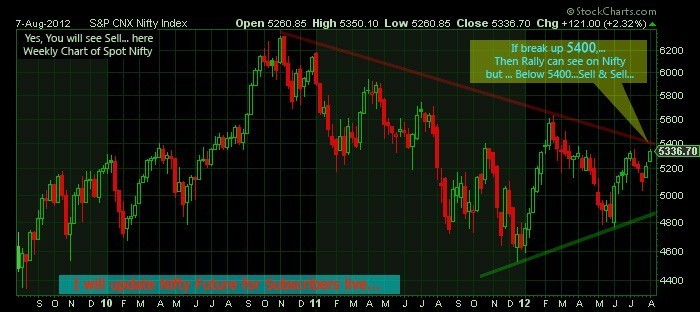
To become a subscriber, subscribe to our free newsletter services. Our service is free for all.
Continue reading

Nifty Future

Nifty Future

(Updated on 03-08-12 Time 08.20 AM)

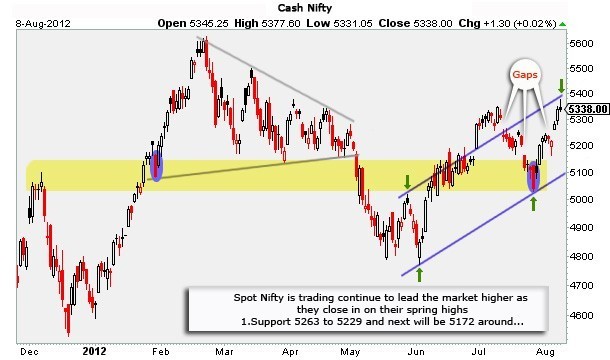
Below 5215 it may slide up to 5200-5192

5250-5265 is intraday resistance.

Below 5192 if sustains with volumes it may go down

up to 5181-5165 in panic sell off.

To become a subscriber, subscribe to our free newsletter services. Our service is free for all.

Continue reading

Share Tips updated on 02-08-2012 at 08.40 am

Kotak Bank

Above 557 with sustained volumes

will kiss 562

Support at 544.

Reliance Industry

Reliance

740-742 strong support.

above 746 will 749-753 levels

Bullish above 735

We gained huge profit in our long counter like

Cipla, Grasim, Reliance, Reliance Infra,

Reliance capital, Lupin.

To become a subscriber, subscribe to our free newsletter services. Our service is free for all.

Continue reading

Nifty Future

Nifty Future

(Updated on 02-08-12 Time 07.40 AM)

Yesterday We indicated that NF would take support at

5225 and 5265 at higher levels.

See the Yesterday’s high at 5266 and low at 5229.

Now today…

Above 5265 if trades with sustained volumes then see

higher levels at 5282-5294.

5294-5300 is strong hurdle zone.

Breakout above 5300 will take it to 5325.

5241-5225 is intraday support.

Below 5225 slide up to 5211-5196.

To become a subscriber, subscribe to our free newsletter services. Our service is free for all.

Continue reading

Markets await ECB action on bond markets, but measures may fall short of raised expectations

FRANKFURT — When European Central Bank head Mario Draghi said that he was ready to “do whatever it takes” to save the euro, he fueled investor hopes the bank would again start buying government bonds to lower borrowing costs for struggling countries.

Just one problem: the ECB has tried bond-buying before. And it didn’t work very well — the action was seen as too hesitant and fell short of decisively lowering borrowing costs for stricken Spain and Italy.

Draghi is certain to face questions Thursday at his news conference after the bank’s government council meets about possible bond purchases and the financial turmoil in Europe.

Last week, Draghi noted that excessive government bond interest rates “come within our mandate” if they are hindering the ECB’s efforts to spread its single interest rate policy throughout the 17 countries that use the euro. That was seized on as a hint the bank might restart its Securities Market Program that bought bonds in the open market, but which has been left dormant since March.

Bond purchases drive their prices up and their interest rates, or yields, down — price and yield move in opposite directions. The ECB’s earlier purchases were able to temporarily drive down the yields — and therefore the borrowing costs incurred by Spain and Italy when they floated new bonds.

Analysts say that Draghi has raised expectations for action so high that markets could be sorely disappointed if no new bold measures are announced Thursday. An interest rate cut from the current record low of 0.75 percent remains a possibility, though many analysts think the bank will wait at least until September. Market attention is most intensely focused on what Draghi will say about the bank’s willingness to influence the market for government bonds.

Slavena Nazarova, an economist at Credit Agricole expects Draghi to emphasize the bank’s willingess to use all its weapons to support the eurozone — but take no new actions: “We are skeptical that such intervention will come as soon as this week, so there is quite a big risk of disappointment for the markets.”

The U.S. Federal Reserve may also leave investors a bit crestfallen, as it considers Wednesday and Thursday whether to do more to stimulate the uncertain economic recovery in the United States. Analysts say it likely will not move to buy more government bonds and stimulate the economy by expanding the supply of money in the economy.

For the ECB, simply re-starting the SMP remains problematic. The bank first used the program in May, 2010 as Greece headed for a bailout, then paused it. It was re-started in August, 2011 as the crisis spread from small countries such as Greece, Ireland and Portugal to countries whose governments are too big to easily bail out — such as Spain and Italy.

But after an initial dip in yields, Spain and Italy soon saw them rise again. The problem was that ECB said the program had to be limited — a statement that kept it from overly impressing the bond market.

On top of this, there was opposition from the Bundesbank, Germany’s central bank and a high-profile member of the ECB’s board. The Bundesbank remains skeptical of bond purchases, saying they come too close to breaking the ECB’s founding treaty, which forbids it from financing