

NIFTY FUTURE 16-8-2012

CASH-NIFTY-INTRADAY.

  • Fall in inflation below 7%, which was below RBI’s comfort level.
  • Today three CAG (Comptroller and Auditor General) reports will be tabled in parliament.
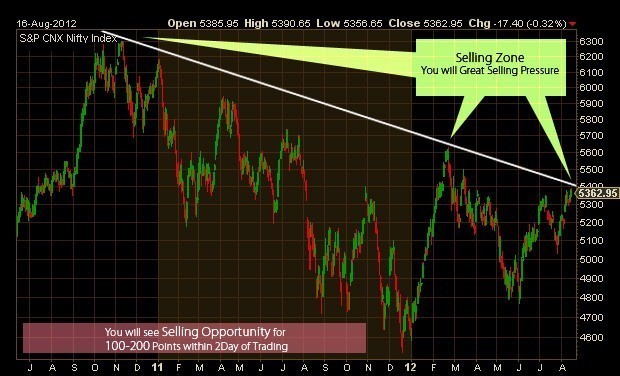
  • Possible resistance at upper Bollinger band which is near 5460 levels.
  • You can think for 5586-5612 if trade 5350 above cash nifty…

BUY NF 5368-5386 and SL 5362 go for targets 5438-5462

To become a subscriber, subscribe to our free newsletter services. Our service is free for all.

Continue reading

Larsen & Toubro updated at 02.30 pm

LT has achieved target of 1454.

Bought at 1437 with stoploss =1431

Still looking bullish and if closes above 1459

for two days then expect 1469-1476

To become a subscriber, subscribe to our free newsletter services. Our service is free for all.

Continue reading
Share Tips Updated on 14-08-2012 at 08.20 am

Jindal Steel & Power

401-397 strong support zone

2 close above 413 may drive it

to 432-434 levels.

Dabur

Good support at 119-121.

3 close above 123 then expect 128-130.

To become a subscriber, subscribe to our free newsletter services. Our service is free for all.

Continue reading

Nifty Futures Intraday Calls

Nifty Future
(Updated on 14-08-2012 at 07.50 am)

Yesterday NF lowered at 5326..85 and then moved up higher at 5377.70

towards the end of the session and closed at 5371.90.

5359-5352 is Intraday support.

If sustains and trades aboe 5365 then expect rally up to 5378-5384.

5391-5397 zone is hurdle zone.

Breaking below 5346 Nf may slide up to 5333-5328.

More details to our Subscribers. To become a subscriber, subscribe to our free newsletter services. Our service is free for all.

Continue reading

China Export Growth Slides as World Recovery Slows

China’s export growth collapsed and imports and new yuan loans trailed estimates in July, adding to signs the global economy is weakening and raising the odds the government will step up measures to support expansion.

China’s export growth was close to zero in July, raising the odds the government will take more-aggressive measures to support growth after industrial output and retail sales data yesterday missed estimates.

Outbound shipments increased 1 percent from a year earlier, the customs bureau said today in Beijing, after an 11.3 percent rise in June. New local-currency lending was 540.1 billion yuan ($85 billion), the central bank said, lower than all 30 estimates in a Bloomberg News survey, compared with 919.8 billion yuan in June.

Stocks slid as the data boosted evidence that China’s interest-rate cuts and accelerated approval of investment projects have yet to propel growth, after a report yesterday showed industrial output rose the least since 2009. The slowdown intensifies risks of a seventh quarter of deceleration in the world’s second-largest economy.

“Monetary policy easing has to be more aggressive in the remainder of the year,” said Liu Li-Gang, Hong Kong-based head of Greater China economics at Australia & New Zealand Banking Group Ltd. He said there’s a risk of a “hard landing” and the government may lower banks’ reserve requirements as soon as today.

The MSCI All-Country World Index (SHCOMP) of global stocks fell 0.3 percent as of 11:02 a.m. in London. China’s Shanghai Composite Index dropped 0.2 percent, the first decline in six days.

Separate reports showed industrial output growth unexpectedly slowed last month to 9.2 percent from a year earlier and retail sales rose 13.1 percent, trailing analysts’ forecasts.

Money Supply

New yuan lending in July compared with the median estimate of 700 billion yuan in a Bloomberg survey. It was the lowest monthly figure since September 2011. Growth in M2, the broadest measure of money supply, was 13.9 percent last month, compared with the median forecast for a 13.8 percent gain.

The growth in July exports compared with the 8 percent median estimate in a Bloomberg News survey. Imports rose 4.7 percent, versus the survey estimate for 7 percent and a 6.3 percent increase in June.

The trade surplus was $25.1 billion in July compared with $31.5 billion a year earlier. The median projection was $35.1 billion.

Excluding distortions caused by the timing of the Lunar New Year holiday, it was the worst export growth since 2009. The figures put China further at risk of missing its 10 percent goal of trade expansion for the year. China is still “confident” of achieving the target, Gao Hucheng, a vice commerce minister, said at a briefing today.

EU Sales

China’s sales to European Union countries fell 16.2 percent last month and growth in U.S. exports slowed to 0.6 percent from 10.6 percent in June, customs data showed.

The odds the government will “greatly step up” policy easing or stimulus are “surely on the rise,” Lu Ting, head of Greater China economics at Bank of America Corp. in Hong Kong, said in a note today. The central bank may cut banks’ reserve requirements “soon” and another interest-rate reduction is “in the pipeline,” Lu said, after two so far this year.

Barclays Plc yesterday cut its estimate for third-quarter growth to 7.7 percent from 8.2 percent while Deutsche Bank AG lowered its forecast to 7.5 percent from 7.9 percent.

China’s central bank halted gains in the yuan in the first half of the year, providing some help to exporters amid deteriorating global demand. The currency has fallen 1 percent against the U.S. dollar this year.

The yuan was little changed against the dollar today at 6.3600, according to the China Foreign Exchange Trade System.

Clothing Supplier

Li & Fung Ltd., the world’s largest supplier of clothes and toys to retailers, plunged in Hong Kong trading by the most since listing in 1992 after slowdowns in the U.S. and Europe caused a slump in first-half operating profit. The company, whose customers include Wal-Mart Stores Inc. and Target Corp., sells goods that are made in China.

Separately today, the Ministry of Finance said fiscal spending rose 37 percent in July from a year earlier, while fiscal revenue rose 8.2 percent.

Elsewhere in the Asia-Pacific region, Singapore said its economy shrank an annualized 0.7 percent last quarter, less than the preliminary reading of a 1.1 percent contraction. Hong Kong said gross domestic product expanded 1.1 percent in the second quarter from a year earlier, compared with the median estimate for a 1.2 percent rise.

German inflation unexpectedly slowed in July to 1.9 percent from 2 percent in June. French industrial production stagnated in June, the latest sign that the euro area’s second-largest economy may be heading for its first recession in three years.

Russian Rates

The Russian central bank refrained from raising borrowing costs for an eighth month, highlighting “significant” inflation risks from a weaker harvest and higher interbank rates that constrain lending growth.

Brazil’s unemployment rate probably fell to 5.7 percent in June, the third monthly decline, based on the median estimate of 35 economists. Canada’s jobless rate may have been unchanged at 7.2 percent in July.

Exports present the biggest uncertainty to China’s outlook, Song Guoqing, an adviser to the People’s Bank of China, said last month. He estimated economic growth may slow to 7.4 percent this quarter.

In its second-quarter monetary policy report released Aug. 2, the central bank said the “primary risk for the global economy is still the European debt crisis,” and that the possibility of Europe “triggering a double dip in the global economy can’t be ruled out.”

Continue reading

TV digitisation: Aug 21 deadline for inter-connection pacts

Signalling a clear intention to implement Cable Digitalisation by the due date, broadcasting sector regulator TRAI has pulled up broadcasters and Multi System operators (MSOs) for not finalising inter-connection agreements and has now set a August 21 deadline for it.

Sources told PTI that in a meeting held yesterday TRAI Chairman Rahul Khullar told broadcasters and MSOs that the regulator will have to step in and decide the tariffs and carriage norms if they failed to finalise these contracts.

The interconnection agreements decide the price and terms at which channels are bought by MSOs from broadcasters for further transmission to cable households.

The Government has already announced that the cable sector would be digitalised in the four metros by October 31 this year and in the rest of the country by December 2014. The finalisation of interconnection is an important pre-requisite for digitalisation of the cable sector.

The inter-connection agreements would also have a bearing on the retail price which the consumer would have to pay for watching these channels, officials said.

Sources said that TRAI officials also expressed unhappiness at the Interconnection Agreements not being finalised despite giving adequate time and the opportunity given for them by both TRAI and MIB.

“Top TRAI officials in the meeting said digitalisation of the cable sector was imperative as it was the will of the Parliament. Any attempt to derail or delay it would not be tolerated,” a well placed source said.

The sources further said that in the meeting TRAI officials informed that the regulator had kept a watch on each development and felt that there was failure on the part of both broadcasters and the MSOs to arrive at mutually negotiated agreements.

Sources said that representatives of broadcasters and MSOs explained that they were under active negotiations and the deals are on the verge of commercial closure.

Sources said that in the meeting some industry representatives sought time up to August 31 but it was not accepted.

After further deliberations in the meeting, it was agreed that both the parties would try to conclude the agreements with major MSOs by 21st August, sources said.

In case of non finalisation of the agreements beyond this date, the result would be stipulation of terms by TRAI, it was decided in the meeting, sources said.

Continue reading