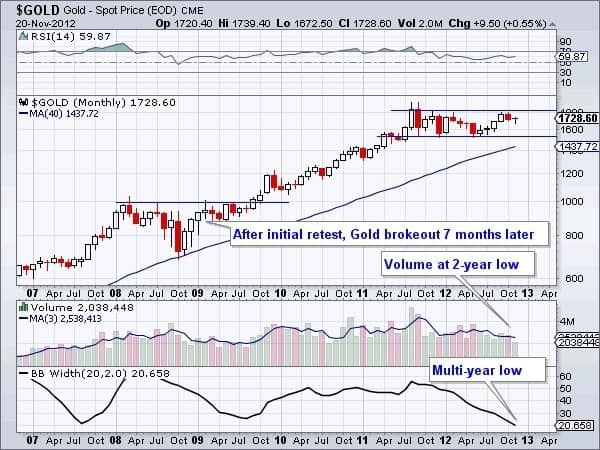
The love for gold has been reignited in India, according to the World Gold Council (WGC) in its Gold Demand Trends for the third quarter of 2012. India regained its title as the strongest performing market, overtaking the greater China area, as the country experienced a bounce-back in demand due to improved sentiment during the festival season.
Compared to the third quarter of last year, Indian gold jewelry demand grew by 7 percent while gold bar and coin demand rose 12 percent. Total consumer demand was 223 tons, compared to 205 tons this time last year. The second largest market was Greater China, which consumed 185 tons in the third quarter of 2012. This was less than the 201 tons consumed in the third quarter of last year.
Together these markets in the east made up 55 percent of the world’s jewelry and investment demand, according to the WGC. Although India experienced a setback earlier this year when gold shops boycotted a proposed tax on the yellow metal, imports recovered by July “as inventory levels were bolstered (aided by a well-timed dip in the local price) and the market adjusted to the customs duty,” says the WGC.
The third quarter has historically been a strong seasonal time for the Love Trade to come alive in the east. Monsoon rains and the festival season in the fall are generally associated with the buying and giving of gold. Still, for the year, don’t expect the Love Trade in India to be as strong as it was in 2011, as gold demand remains subdued with the ongoing weakness of the rupee.
The purpose that I had in mind when I began this blog in 2010, was to give investors some insight into how the markets worked. Several blogs gave readers basic investing guidelines that were tried and true, and which stood the test of time. In my readings this week, I came across some writing from Gatis Roze, who was repeating the wisdom of Jesse Livermore, a legendary person in the markets. Some of the comments pertained to methods of trading, but some were also pertinent for value investors. I will quote extracts from that writing herein. The following is valuable and mirrors my commentary.
The Most Important Rule is Patience
If you are a trader, you are competing against modern technology that measures trades in milliseconds, rather than seconds. Some say that 80% of all trades are from computerized trading programs, that operate faster than any human could ever trade. Without massive expenditures on technology, day trading is a losing game.
Trend trading, which essentially is trying to find and interpret trends, and then follow them, is alive and well, but again computerized trading is usually better and faster at this than mere humans.
Value Investing
That leaves the good old value investing. In the long run, finding value, buying that value and sticking with that value, provides a good profit over time. In finding value, it is essential to realize that not every pick will be the right one. Factors that are unknown to you, or changes in the environment of that stock over time, will cause the loss of value that you cannot predict. Spreading the risk, mitigates this problem. I don’t believe in diversification in sectors as a basic tool. This simply ensures that profits in one sector will be offset by losses in another.
Spreading the risk means having a large enough number of value stocks in your portfolio, to ensure that the occasional loser will be offset by a number of winners.
But the very basic rule of investing, is to have patience. Ignore the screaming headlines, the stock market pundits, the media that has to fill the screens to sell advertising. Have patience with good value.
Some excepts from that blog follow:
The Secrets I Learned from Jesse Livermore Posted: 2012-10-19
When seasoned traders get together, we have a sort of “secret handshake” that the uninitiated may not notice. We ask each other if they’ve read “Reminiscences of a Stock Operator”. The insiders reply by telling you the number of times they’ve read the book. Novices ask for the author’s name.
Money Management:
* “I trade on my own information and follow my own methods.”
Business of Investing:
* “I believe that anyone who is intelligent, conscientious, and willing to put in the necessary time can be successful on Wall Street. As long as they realize the market is a business like any other business, they have a good chance to prosper.”
* “It cost me millions to learn that another dangerous enemy to a trader is his susceptibility to the urgings of a magnetic personality when plausibly expressed by a brilliant mind.” (In simple terms, IGNORE THE PUNDITS. If they know so much, why ain’t they rich?
Buying (Averaging Down):
* “It is foolhardy to make a second trade, if your first trade shows you a loss. Never average losses. Let this thought be written indelibly upon your mind.”
Monitoring (Patience):
* “After spending many years in Wall Street and after making and losing millions of dollars, I want to tell you this: It never was my thinking that made the big money for me. It was always my sitting. Got that? My sitting tight!”
Selling (Get Rid of Losers):
* “Losing money is the least of my troubles. A loss never troubles me after I take it. I forget it overnight. But being wrong – not taking the loss – that is what does the damage to the pocket book and to the soul.”
Trade well; trade with discipline!
– Gatis Roze
How to Make Money in the Stock Market
Repeating these basic rules in simple terms follows. Violating these rules makes losing money in the stock market more probable than making money in the stock market. Remember that for every winning trade, someone has a losing trade. The trick is to tilt the odds as far as you can in your favor, to put the odds on your side.
Rules of Investing
First, buy value stocks; stocks that make sense to you; stocks that are not the hot ones of today, but the long term excellent assets.
Next, ignore the media; ignore the hype; ignore the screaming headlines. If you want to prove this point, try and remember the last time you heard a commentator admit to picking a losing stock. To listen to them, they have never picked a losing stock.
Next, diversify. Forget about sectors. Diversify by picking a bunch of value stocks and never put too much into any one stock.
Next, have patience. You will always have a loser or two. But quality will win in the long run.
Next, judge your stocks. When a pick goes bad, get rid of it. Losers usually stay losers. Redeploy your capital elsewhere.
Next, never ride a stock to the moon. When you have a good profit, move on, with at least some of your profits.
Next, never, ever, average down. A loser is a loser. Doubling your losses is never a wise policy.
Lastly, we believe in the juniors for the most part, and we believe in resources. A winner in the junior resource sector can be a 10 bagger or a 20 bagger. That compensates for a lot of losers.
Summary
Smart investors always make money. Here are some simple rules to follow that are tried and true. They worked well last year, 50 years age, and will work well in 50 years.
On its way down from 168, GLD broke its first support level and came to rest on the second (200-DMA) from which it had a bounce. Last week, I suggested that it might find some resistance on the small horizontal red trend line, which it has, and which caused it to pull back three points. It’s difficult to see how it could have much more of a decline right away if the market is going to have a mid-correction rally, so we can probably expect the near-term trend to turn up again, perhaps reaching the top channel line (blue) before rolling over again.
If GLD does not have much of a rally from here – especially if the market does rally – it will be an indication that some decent weakness can be expected into the cycle low. In any case, subsequent action should form a P&F pattern which will help us determine the extent of the decline into the 25-wk cycle low.
UUP (dollar ETF)
UUP normally goes against equities and gold. The index appears to be extended short-term and eady to pull-back. This can be seen in the indicators, one of which is very overbought and the other beginning to show some negative divergence. If a short-term top is forming, this should help the market to find a short-term low.