

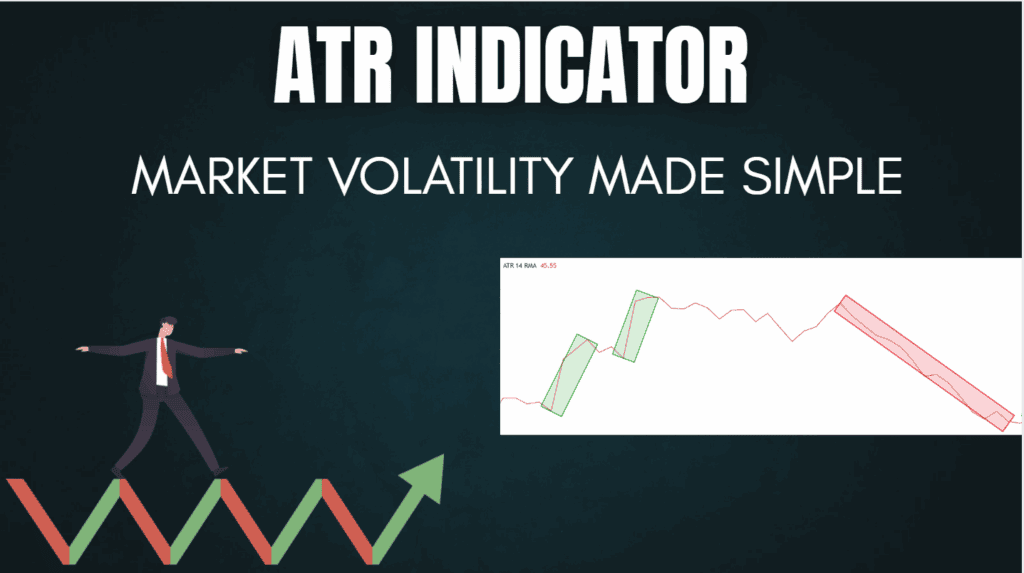

If you’ve ever traded stocks, forex, or even crypto, you’ve probably noticed that some days the price hardly moves, while on other days it swings wildly. This “movement” in price is called volatility, and one of the most popular ways traders measure it is through the ATR – Average True Range.
ATR was introduced by J. Welles Wilder Jr. back in the late 1970s. Unlike indicators that tell you whether the market is bullish or bearish, ATR doesn’t care about direction at all. Instead, it tells you how much the price usually moves over a certain period of time
What ATR Actually Shows
- A high ATR means the market is very active, with big price swings.
- A low ATR means the market is calm, with smaller movements.
That’s it. Simple. It’s not about predicting whether the price will go up or down, but about showing how “wild” or “quiet” the market is.
How ATR is Calculated (Without the Math Headache)
Technically, ATR is based on something called True Range (TR), which looks at:
- Today’s high vs. today’s low
- Today’s high vs. yesterday’s close
- Today’s low vs. yesterday’s close
Whichever of these differences is the biggest becomes the “true range” for the day. ATR is then just the average of these ranges over a certain period (commonly 14 days).
Why Traders Use ATR
- Stop-Loss Placement:
Traders don’t just put a random stop-loss. They often use ATR to decide how far it should be. For example, if a stock’s ATR is 10, a trader might put a stop-loss 15 points away from entry (1.5 × ATR). - Sizing Positions:
When volatility is high (ATR big), traders reduce their lot size to control risk. When volatility is low, they might increase it. - Spotting Breakouts:
If ATR suddenly jumps while the price breaks out of a range, it usually means the move has strength behind it.
How to Use ATR in Trading
ATR about understanding how much the price moves. Once you know that, you can use it in practical ways:
1. Setting Stop-Loss Levels
One of the best uses of ATR is for stop-loss placement.
- If you set your stop-loss too close, normal price swings might hit it.
- If you set it too far, you risk losing more than necessary.
ATR solves this problem. Example:
- ATR = 10 points
- You can set your stop-loss 1.5 × ATR = 15 points away from entry.
2. Deciding Position Size
- High volatility = higher risk.
- Low volatility = lower risk.
Traders often reduce their trade size when ATR is high (to avoid oversized losses) and increase it when ATR is low (since risk is naturally smaller).
This way, your stop-loss is adjusted to the asset’s natural volatility.
3. Identifying Breakouts
If the price breaks an important support or resistance level and ATR is rising, the breakout is more reliable.
- Breakout + Rising ATR → strong move, good confirmation.
- Breakout + Falling ATR → weak move, could be a fake-out.
4. Knowing When to Stay Out
When ATR is extremely low, it usually means the market is stuck in a narrow range. Trend-following traders often avoid trading during these periods, since profits are limited.
5. Setting Profit Targets
Some traders also use ATR to set realistic profit targets. For example, if ATR is 8 points, aiming for a 30-point move may be unrealistic. Instead, they target 1×ATR or 2×ATR moves.
Think of ATR as a “mood meter” for the market. It doesn’t predict the future, but it helps you understand if the market is in a calm phase or a stormy one. Used along with other tools (like moving averages, RSI, or support/resistance levels), ATR can make your trading decisions a lot smarter.
Get free important share market ideas on stocks & nifty tips chart setups, analysis for the upcoming session, and more by joining the below link: Stock Tips
Have you any questions/feedback about this article? Please leave your queries in the comment box for answers.
