Mr.Guru (s)

Mr.Guru(s) is a team of stock market certified technical and research analysts with over 20 years of experience. They are regular guests on popular online channels and contribute articles to several financial publications. Their insights and advice are respected by investors worldwide. With their collective knowledge and expertise, they have a proven track record of successfully predicting market movements and identifying profitable opportunities.

Join Today (Free): Stock & Nifty Tips

Part 1: A simple analysis of Wyckoff of Wall Street

wyckoff trading pattern

Wyckoff was a pioneer in the technical analysis of the stock market in the early 20th century. He established the Stock Market Academy in 1930. The main course is to introduce how to identify the dealer’s process of collecting chips and the process of distributing chips/judge. Second and third, in the basic law of “causality”, the horizontal P&F count within the trading range represents the cause, and the subsequent price changes represent the result.

Fourth, fifth, the relationship between price and volume on the candlestick chart to analyze the relationship between supply and demand. This law sounds simple, but it takes a long time to practice in order to accurately grasp the volume and price. I heard that Wall Street financial institutions are using Wyckoff’s trading method to judge the trend of the stock market and look for opportunities. So what exactly is Wyckoff’s theory? Today, I will introduce to you the famous Wyckoff transaction method.

The background of the birth of Wyckoff theory

Wyckoff’s theory was proposed by Richard Wyckoff. He was a pioneer in the technical analysis of the stock market in the early 20th century. He and Dow Jones, Gunn, Elliott, and Merrill Lynch are considered the five giants of technical analysis.

Wyckoff is good at summarizing his years of failures in stock investment, and is committed to introducing individual investors to the rules of the game in the market and the impact of large funds behind them.

In 1930, he established the Stock Market Academy. The main course is to introduce how to identify the dealer’s process of collecting chips and the process of distributing chips. Till, there are still many professional traders and institutional investors applying Wyckoff’s method.

Two Five Steps of Wyckoff Analysis

(1) Determine the current state of the market and possible future trends.
Judging the current market trends and future trends can help us decide whether to enter the market and go long or short.

(2) Choose stocks that are consistent with market trends.
In an uptrend, choose stocks that are trending stronger than the market. In a downtrend, choose stocks that are weaker than the market.

(3) Choose stocks whose “reason” equals or exceeds your minimum target.
An important part of Wyckoff’s trading selection and management is his unique method of using long-term and short-term trading point forecasts to determine price targets.

In Wyckoff’s basic law of “causality”, the horizontal P&F count within the trading range represents the cause, and subsequent price changes represent the result.

(4) Make sure that the stock is ready to move.

(5) When the stock market index reverses, there must be contingency measures
Three-quarters of the stocks are moving in line with the market. Grasping the market trends can increase the success rate of transactions.

Wyckoff Price Cycle Pattern Chart

Continue reading

EWT: Will Nifty Hit 18000 Before September End?

free nifty stock tips daily chart

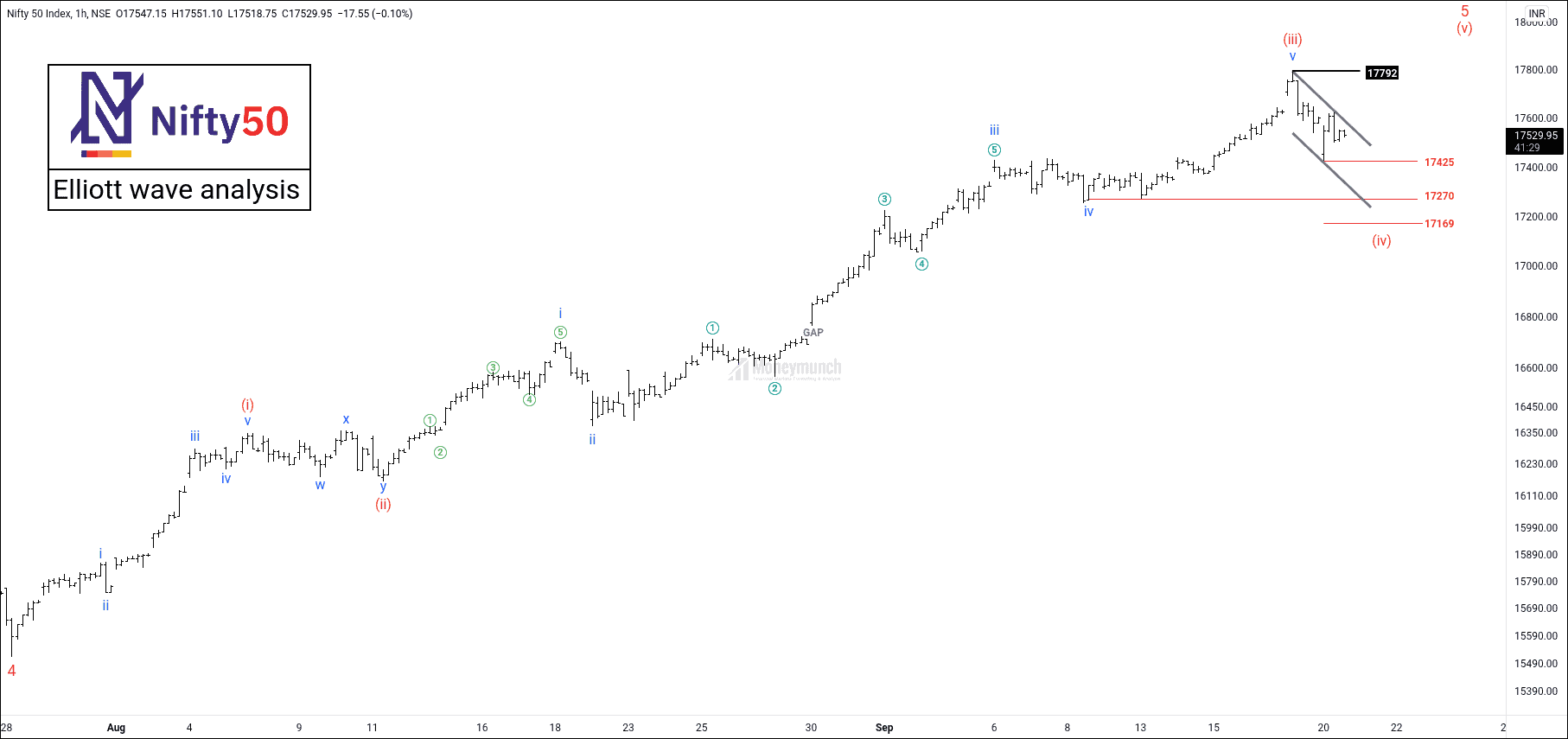
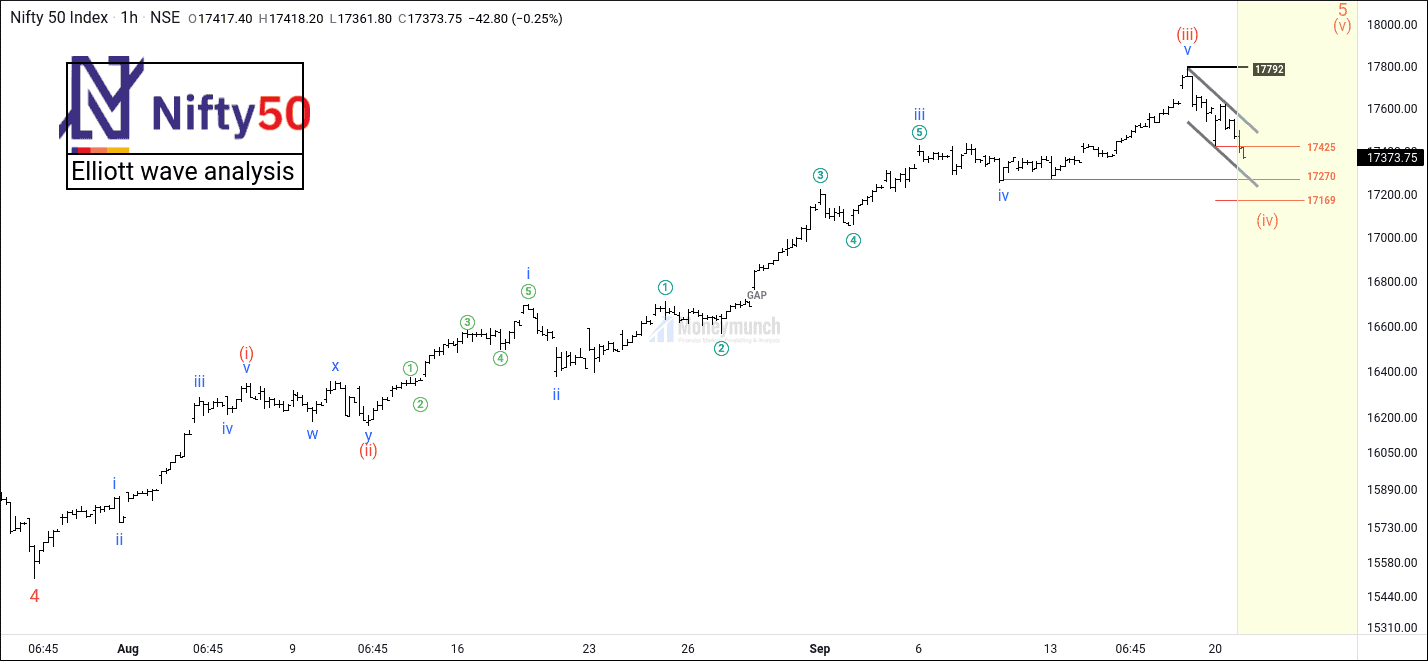
Extending wave (5) should easily travel above 18000 and is likely to continue toward 18480.

Target 1: 18000
Target 2: 18142
Target 3: 18350
Target 4: 18480

To become a subscriber, subscribe to our free newsletter services. Our service is free for all.

Continue reading
Trade-Setups on Maruti Short Target 6639 and 6483

How to find the next wave after the development of extended waves?
Two terms are important to understand for this Sample.
  • Extended Wave – The biggest wave of three impulsive waves (W1, W3, or W5) for the motive phase. In this, we expect gaps, surged, sharp moves in it.
  • Difference between points – A wave has two points, the starting and ending point. The distance between them is the difference between those points. For example, Wave 1 traveled from Rs. 30 points to Rs. 45 point. As a result, the difference between 45- 30 points is “15”.
The formula that we will use to find the 5th wave:

Difference of, 5th Wave = 3rd wave Extended – 1st WaveContinue reading

RELIANCE: EW target and Reversal point for ABC correction

We’ve traded today

This CALL was given to our SUBSCRIBERS:

NIFTY Sell below 14719 for targets 14576 and stop-loss 14745
This trade was achieved by us.

Traded Level 14719, Target 14576, equals to 143 points profit and stop-loss only 26 point. The PROFIT is 10,725 just only in 1 lot sizeTo become a subscriber, subscribe to our free newsletter services. Our service is free for all.

RELIANCE:

This stock price moving to 2193 and 2235 as target. As per the Daily chart the correction can be 2250-2230.

EW on Daily chart

EW on Weekly chart.

Continue reading

Parallel Channel and use of it over the NIFTY

We found that a price is frequent spending more and more time between “Upper-Band” & “Gravitation line”. In other words, a price staying much of time between “Upper-Band” & “Gravitation line”.
Look at the upper-bank has 6 touches.
We are seeing no activities between the lower band and control price. That’s why we concluded that if price breakdown, gravitation line will be confirmation of fall. Yes, you can take profit from this type of trend by using buy at control price and sell at the upper band.

To become a subscriber, subscribe to our free newsletter services. Our service is free for all.

Continue reading