

Getting Things Done!

secret-weapon-for-getting-things-done

It’s fun to think about a new business idea or trading concept or personal life goal — the visualization phase is the exciting part — but as soon as the hard, gritty work of getting traction comes into play, a lack of self-discipline means sudden lost interest. Many people live their entire lives this way, pepping themselves up with routine daydreams but never accomplishing anything. It’s really terrible!

On a meta level, the perspective of “Granny’s rule” means understanding, on a deep intuitive level, that all worthwhile successes require “eating the carrots before you get desert”… putting in the sweat equity and the diligence as a matter of first-priority habit, with a stone-cold focus on earning the rewards, not collecting passively via hope or dumb luck. “As you sow, so shall you reap.”

As a bonus, here are the summarized 21 “Eat that Frog” principles. Can you use any of these to step up your game? priority

1) Set the table. Decide exactly what you want. Clarity is essential. Write out your goals and objectives before you begin. 2) Plan every day in advance. Think on paper. Every minute you spend in planning can save you five or ten minutes in execution. 3) Apply the 80/20 Rule to everything. Twenty percent of your activities will account for eighty percent of your results. Always concentrate your efforts on that top twenty percent. 4) Consider the consequences. Your most important tasks and priorities are those that can have the most serious consequences, positive or negative, on your life or work. Focus on these above all else. 5) Practice the ABCDE Method continually. Before you begin work on a list of tasks, take a few moments to organize them by value and priority, so you can be sure of working on your most important activities.

Focus-On-Your-Dreams

6) Focus on key result areas. Identify and determine those results that you absolutely, positively have to get to do your job well, and work on them all day long.>

7) The Law of Forced Efficiency. There is never enough time to do everything, but there is always enough time to do the most important things. What are they?

8) Prepare thoroughly before you begin. Proper prior preparation prevents [piss] poor performance.

9) Do your homework. The more knowledgeable and skilled you become at your key tasks, the faster you start them and the sooner you get them done. 10) Leverage your special talents. Determine exactly what it is that you are very good at doing, or could be very good at, and throw your whole heart into doing those specific things very, very well. 11) Identify your key constraints. Determine the bottlenecks or check points, internally or externally, that set the speed at which you achieve your most important goals and focus on alleviating them.

12) Take it one oil barrel at a time. You can accomplish the biggest and most complicated job if you just complete it one step at a time.

13) Put the pressure on yourself. Imagine that you have to leave town for a month, and work as if you had to get all your major tasks completed before you left. 14) Maximize your personal powers. Identify your periods of the highest mental and physical energy each day and structure your most important and demanding tasks around these times. Get lots of rest, so you can perform at your best.

images

15) Motivate yourself into action. Be your own cheerleader. Look for the  good in every situation. Focus on the solution rather than the problem.  Always be optimistic and constructive. 16) Practice creative procrastination. Since you can’t do everything, you must learn to deliberately put off those tasks that are of low value so that you have enough time to do the few things that really count. 17) Do the most difficult task first. Begin each day with your most difficult task, the one task that can make the greatest contribution to yourself and your work, and resolve to stay at it until it is complete. 18) Slice and dice the task. Break large, complex tasks down into bite sized pieces, and then just do one small part of the task to get started. 19) Create large chunks of time. Organize your days around large blocks of time when you can concentrate for extended periods on your most important tasks. 20) Develop a sense of urgency. Make a habit of moving fast on your key tasks. Become known as a person who does things quickly and well. 21) Single-handle every task. Set clear priorities, start immediately on your most important task, and then work without stopping until the job is 100% complete. This is the real key to high performance and maximum personal productivity.
Continue reading

What Are Defensive Stocks?

MEANING OF THE DEFENSIVE STOCK:

defensive-stocksStocks are categorized as defensive based on parameters which are the measure of the stock-price change compared to the overall stock market change, the return on equity (ROE). Defensive stocks naturally have a beta of less than 1. A beta of 1 means the stock price moves at the same rate as the overall market, whereas a beta of less than 1 would mean that the stock would move up and down.

The stock’s average ROE of the last five years should be higher than 25%

The stock should have an eye-catching dividend yield and the company should have a history of firm dividend payments. A dividend yield of greater than 3-4% on a consistent basis would be a good measure.

There are many people who try to go for government treasury bonds because they think that these are the best plan for future. They always get reward from these plans. But here too, there is some amount of risk that is associated with the stock market. Therefore, defensive stock investing means taking affordable risks in the market. In defensive stock investing, you need to check how much you would be able to spend on your investment in the stock market without cutting any costs of your daily costs. It would be best for you if you can ask a good stockbroker. He would be able to guide you the little information about stock market. Being in the professional field of stock market for several years, he would have much knowledge of the market. Even if you wish to go for day trading, then you can ask him as there are many investors who fear of financing in such type of exchange as they study it very risky.

Continue reading

Wyckoff Chart Reading

Chart reading

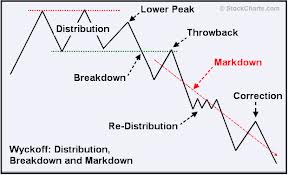
The Wyck­off Method is one of the four time­less approaches to mar­ket analy­sis (the other three being Dow The­ory, Shabacker’s chart pat­terns, Elliott Wave The­ory and Gann’s swing trad­ing approach). It was devel­oped in the early part of the 20th Cen­tury and has been con­tin­u­ously refined through the present day. The Wyck­off Method is a vital, clas­sic approach to trad­ing which reads the mar­ket through price bars and vol­ume. Although tech­ni­cal indi­ca­tors may be used, they are unnec­es­sary under the Wyck­off Method.

Richard D. Wyck­off was a Wall Street bro­ker and trader in the early part of the 20th Cen­tury. Wyck­off was a bro­ker and wit­nessed the oper­a­tions of the largest traders of his day first hand as an ‘insider’ and learned to trans­late their activ­i­ties in the ticker tape and bar charts. As he watched traders and investors make poor trad­ing deci­sions based on rumor, opin­ion and guess­work, he wrote a newslet­ter that quickly became so widely read on Wall Street that it would often affect stock prices. He later wrote courses for traders and books on tape read­ing (includ­ing the first day trader’s man­ual) and his expe­ri­ences on the Street.

The Wyck­off Method has been used by astute traders for nearly 80 years. It is a com­plete method for under­stand­ing and trad­ing the mar­kets. It is used effec­tively by day traders, swing traders and investors in all mar­kets includ­ing equi­ties, com­modi­ties, index futures and FX with equal suc­cess. Many of today’s top mar­ket tech­ni­cians acknowl­edge Wyck­off as the basis for their under­stand­ing of the mar­kets, and the Method has spawned spin-offs such as VSA.

Dr. Gary Day­ton is an expert in the Wyck­off Method. He has stud­ied and applied Wyck­off for the past decade and has been men­tored by an acknowl­edged Wyck­off mas­ter. Dr. Gary is also an out­stand­ing edu­ca­tor of the Method who con­veys the Wyck­off Method and prin­ci­ples in a sim­ple and con­cise man­ner eas­ily under­stood by his students.

TABLE OF CONTENTS

Candlestick and Chart Patterns (15 Days)

7 Most Important Candlestick Chart Patterns

Top 2 Bearish Chart Patterns

Top 6 Bullish Chart Patterns

Indicators & Oscillators (12 Days)

Bullish or Bearish Indicators

Bullish or Bearish Oscillators

Classic Chart Patterns (29 Days)

Bearish Classic Chart Patterns

Bullish Classic Chart Patterns

Best Trading Theories (4 Days)

Kind attention: this course is helpful for beginner and intermediate traders. It’s free for everyone. Advanced modules, trading strategies, and data (in-depth) are available for Moneymunch’s premium subscribers.

Get free important share market ideas on stocks & nifty tips chart setups, analysis for the upcoming session, and more by joining the below link: Stock Tips

Have you any questions/feedback about this article? Please leave your queries in the comment box for answers.

Disclaimer: The information provided on this website, including but not limited to stock, commodity, and forex trading tips, technical analysis, and research reports, is solely for educational and informational purposes. It should not be considered as financial advice or a recommendation to engage in any trading activity. Trading in stocks, commodities, and forex involves substantial risks, and you should carefully consider your financial situation and consult with a professional advisor before making any trading decisions. Moneymunch.com and its authors do not guarantee the accuracy, completeness, or reliability of the information provided, and shall not be held responsible for any losses or damages incurred as a result of using or relying on such information. Trading in the financial markets is subject to market risks, and past performance is not indicative of future results. By accessing and using this website, you acknowledge and agree to the terms of this disclaimer.

The Strongest Market Signal

The two approaches to market timing—predictive and confirming—almost always give conflicting signals when analyzing movements of the same time domain. That is okay because they are used for different purposes and have different goals. If contrary opinion says that the market has reached bottom over the intermediate term, the other approach—trending indicators for the intermediate term—almost always indicates that the trend is still down. This is normal. Why? Because it is normal that investors become very bearish (furnishing us with buy signals using contrary opinion)as prices are plummeting and at their low. The large price drop makes the trend indicators point down, but the predictive indicators are showing that the end of the decline has been reached, and higher prices are ahead. However, there are times when the two approaches do not give conflicting signals, and these are very important to note. When predictive indicators such as contrary opinion strongly indicate higher prices, and the confirming indicators have already confirmed the start of a slight uptrend, that is the strongest buy signal there is. There is nothing more reliable or important than when this unusual situation happens. Why is this so? It is expected that, as prices move up, more and more investors will become bullish. When, however, the bearish sentiment stays high or even moves higher than prices also move higher, that is not expected, and so it is the sign of a very strong stock market. At these moments, what is happening is that no one believes the upward price movement is real or that it will last. This skepticism is the fuel needed to keep the movement going, usually for some time. The same holds true when both categories of indicators are confirming that prices are declining. If contrary opinion is extremely bullish and stock prices have already started down, so much so that trend-following indicators are confirming the downtrend, there is no more reliable or important sell indicator.

Continue reading

No takers for IDBI bank’s Minerva theatre which ran Sholay for 5 straight years

minerva thertre

IDBI Bank has a piece of Bollywood’s 100-year-old history, but no one seems to be interested in it. The only one who found it worthwhile is broke and has been ordered to shut down. The plot on which stood the Minerva theater in South Mumbai, known as the Pride of Maharashtra, which crated history by running Amitabh Bachchan-starrer Sholay for five straight years, is now on the books of IDBI Bank. And the lender does not know what to do with it…

The state-run bank recently failed for the third time to sell the plot on Lamington Road, which has the potential to build and sell real estate for 40,000 square feet. That’s as much a surprise as it is a shock in a city where the fight for land can take many twists and turns. If a mouth-watering deal for real estate developers is going with no attention, what’s the catch?

Like an impediment for most other economic activities – it is an archaic law. A rule says that in any piece of land where a theater once stood, there is no other option than building another theatre after razing the old one. “We have not decided what we will do with it,” says RM Malla, chairman and managing director at IDBI Bank. “It has to have a screen. Even a mini screen will do.”

For IDBI, it was funding an exotic idea that went sour.

In 2006, it lent about Rs 40 crore to Neville Tuli, the pioneer of art investing in India, through Osian’s Connoisseur’s Art, to build a theater and an exhibition center named OSIANAMA. The idea was to bring international movie experience to India. Reality did not unfold the way it was forecast to. The economy collapsed, value of assets tumbled and so did the fortune of Osian. All that stands now is a barren land with the once iconic structure pulled down.

Dues rose to Rs 84.8 crore in the period. First, IDBI decided to auction it at Rs 70 crore, that failed. Then, reduced the asking price to Rs 61 crore – still no takers.

Osian’s Connoisseurs of Art is having its own difficulties with the regulator Securities & Exchange Board of India (Sebi), which is directing it to wind up for violating securities laws.

Osian’s “is directed not to access the capital market and is further restrained and prohibited from buying, selling or otherwise dealing in the securities market till its collective investment schemes are wound up and all the monies mobilised through them are refunded to the investors,” the Sebi order said.

Planning a residential tower, along with a multiplex and a retail component, may not be a good idea elsewhere, but won’t find takers in the elitist South Mumbai.

Continue reading

FinMin makes case for rating upgrade with Fitch

rating

The finance ministry on Friday made a strong case for rating upgrade of the Indian economy by global agency Fitch Ratings on the back of increasing investments, declining import of gold and the government’s commitment to fiscal prudence.

The issue of rating upgrade was raised by the ministry’s officials at a meeting with the representatives of Fitch in New Delhi. The meeting was attended by Department of Economic Affairs Secretary Arvind Mayaram, among others.

“Fitch raised concerns on how deficits will be met and how the government will be able to meet revenue targets. We said we are confident, gold import is declining and investment in our economy is going to start increasing,” a top  official said.

The official further said the finance ministry also expressed confidence that the current account deficit would come down, as oil prices were stable and the rupee had been range bound.

“The Cabinet Committee on Investment (CCI) has approved projects worth Rs 70,000 crore in three months time. These are infrastructure projects and will have positive impact on cement industry and steel industry,” the official added.

The government had set up CCI, under Prime Minister Manmohan Singh, in December last year to accord fast track clearances to mega projects.

The Ministry officials also impressed upon the rating agency the resolve of the government to follow the path of financial prudence and bring down the fiscal deficit to 3 per cent of GDP by 2016-17.

Finance Minister P Chidambaram in 2013-14 Budget has proposed to bring down the fiscal deficit to 4.8 per cent from 5.2 per cent in 2012-13.

Besides, several reforms initiative like liberalising FDI norms for various other sectors, including multi-brand retail, was undertaken by the government to promote growth and investment.

The government also undertook partial decontrol of diesel and capped subsidised LPG cylinders, in a bid to check the rising subsidy bill.

Another rating agency Standard & Poor’s is scheduled to visit India on April 25.

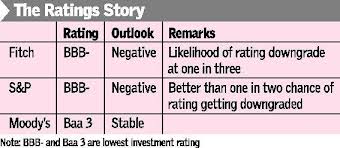
Both S&P and Fitch had earlier threatened to downgrade India’s credit rating as an aftermath of the expansionary policy which led to a rising fiscal deficit. The fiscal deficit had touched a high of 5.8 per cent in 2011-12.

S&P rates India as ‘BBB-‘, lowest in the investment grade, with a negative outlook. Any further downgrade will push India’s rating to the junk status, making it difficult and costlier for Indian entities to borrow funds overseas.

After lowering India’s credit outlook to negative, Fitch had in August last year said the possibility of downgrading the country’s sovereign rating is more than 50 per cent in the next 12-24 months unless reforms are carried out.

Continue reading